The four defenses in numbers
Costs are for planting and then each upgrade; intervals are between shots at levels 1, 2 and 3. One tile is one grid cell.
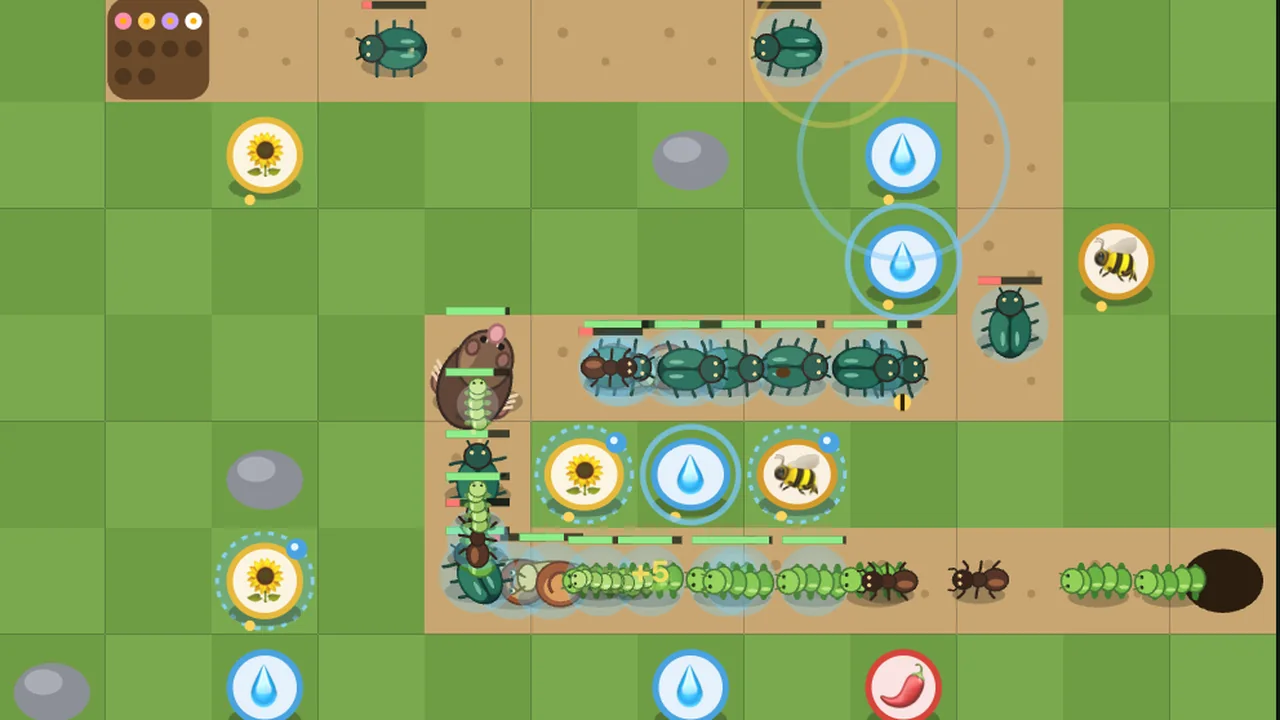
- Sunflower: 45, then 40 and 65 (150 in all). 10, 16 and 26 damage every 0.67, 0.53 and 0.53 s, range 2.6, rising to 3.0 at level 3. Hits moths.
- Sprinkler: 45, then 40 and 60 (145). 6, 10 and 16 damage once a second to every ground pest in range 1.8 (2.2 at level 3), and each spray slows them to 60%, 50% or 45% speed for a second, so a pest that stays in range stays slowed.
- Beehive: 75, then 60 and 90 (225). 20, 38 and 58 damage every 1.5 s over a 0.9-tile splash (1.2 at level 3), range 3.2. Hits moths. The bees fly at 6 tiles a second, slower than seeds.
- Pepper: 90, then 80 and 120 (290). 90, 150 and 240 damage, every 1.67 s and 1.4 s at level 3, range 2.2 and 2.4 at level 3. Ignores armor, cannot hit moths.
What a coin buys
Dividing single-target damage per second by coins spent gives a rough price for each step. A sunflower gives about 0.33 damage per second per coin at every level, so its upgrades are fair but not special; level 2 is the best of them at 0.375 for its 40 coins. A pepper gives about 0.6 at level 1, and its upgrade to level 3 is the best value in the game: 81 extra damage per second for 120 coins, or 0.68 per coin. A beehive’s 0.18 looks poor until you count the splash, which hits every pest within 0.9 tiles of the target.
Those figures assume every shot lands on something that needs it. A level 3 pepper’s 240 on a 30-health ant wastes most of the shot, so peppers pay on beetles, snails and the mole, and sunflowers and beehives pay on crowds of small pests.
Armor changes the table
Every non-pepper hit loses the target’s armor, 3 for beetles and 2 for the mole, down to a minimum of 1. Against a beetle a level 1 sunflower deals 7 per seed, a level 1 sprinkler 3 and a level 1 beehive 17; the pepper still deals its full damage. Beetles have 150 base health, which grows to 345 on wave 6 and 462 on wave 9, so a beetle on wave 9 takes 66 level 1 seeds or two level 3 pepper shots.
Pests, paths and how long they take
- Ant: 30 health, 1.6 tiles a second, 3 coins. Snail: 95, 0.8, 6. Beetle: 150, 1.1, 10, armor 3. Caterpillar: 65, 1.3, 5, then two larvae worth 1 coin each (22 health, 1.7). Moth: 45, 1.9, 5, flies. Mole: 1,300, 0.55, 60 coins, armor 2, eats 3 flowers.
- Every pest’s health is multiplied by 1 + 0.26 for each wave after the first, so a wave 10 pest has 3.34 times its base health; themed waves then scale it (70% for broods and moth clouds, 90% for ant swarms).
- Path lengths: Pondside 22 tiles, Front Yard 24, Veggie Patch and Meadow 25, Greenhouse 30. An ant needs 14 to 19 seconds to walk them, a snail 28 to 38.
- Moth lines are straight: 7.6 tiles on the Greenhouse (4 seconds), 10.8 to 11.7 elsewhere (about 6 seconds).
Where to plant
Path inside a tower’s range is time a pest spends being shot. On every garden the best tile for a sunflower covers 10.5 to 10.8 tiles of path, about twice the 4.2 to 5.6 of an average buildable tile, because it sits inside a bend where the path passes on two or three sides. For a beehive the best tile covers 12.5 to 15.8 tiles. Spend a while finding those bends before the first wave; nothing moves until you press Start first wave.
A sprinkler’s slow multiplies that time: an ant slowed to 60% spends two-thirds longer on the stretch the sprinkler covers, inside the range of every tower that covers it too. Put the sprinkler where the path runs through the ranges of your attackers, and put the attackers on its eight neighbouring tiles, which also water them for a shorter firing interval.
Where the coins come from
Across 400 generated rounds, kill rewards averaged 39 coins on wave 1, 74 on wave 3, 164 on the first mole wave and 241 on wave 10. Each wave fully cleared adds 20 + 5 × the wave number coins, from 25 to 70. A normal round pays about 1,780 coins on top of the 150 you start with, so the opening buy is less than a tenth of what you will spend.
Calling a wave early pays 1 coin and 2 points for each whole second left of the 18-second break, which opens once the last pest of the current wave has appeared. In score terms that is small next to flowers: on a win each flower is worth 100 and each spare coin 1. In 40 rounds my scout test bot won 38, averaging 2,662 points: 1,298 from kills, 300 for waves held, 62 from early calls, 837 from flowers and 165 from leftover coins.
A first round, step by step
- Before the first wave: wave 1 is always ants and snails, about ten pests. Two sunflowers on the best bend with a sprinkler beside them costs 135, waters both and slows everything that passes.
- After wave 1 (about 39 coins from kills plus a 25-coin bonus), read the preview. Wave 2 is either an ant swarm or a caterpillar brood, and both call for a beehive.
- Wave 3 was a moth cloud in 68% of 400 seeds. Before it, check the share of the moth line your sunflowers and beehives reach and add a sunflower near the flowers if it is low.
- By wave 5 you need a pepper for the mole; the armored march comes somewhere in waves 6 to 9, and peppers are the answer there too.
Moles in detail
The mole arrives last in waves 5 and 10 with 2,652 and 4,342 health. At 0.55 tiles a second it needs about 44 seconds to walk Front Yard, which gives every tower on the route a long look. The first time its health drops below half it burrows for 1.5 seconds, moving 1.3 times faster and ignoring slow, so it covers about a tile underground, and shots already flying at it miss. It eats 3 flowers and pays 60 coins, the largest reward any pest gives.
Common mistakes and why they cost
- Planting peppers against ant swarms. Most of each 90-damage shot is wasted on 30-health targets.
- Counting on sprinklers for damage. Their 6 per second matters less than the slow they give the towers around them.
- Moving towers by selling. After the first shot or five seconds a sale returns only 70%.
- Hoarding coins. Spare coins score 1 point each and only on a win; a 45-coin tower that saves one flower is worth 100.
- Calling waves early with thin cover. The most an early call can pay is 18 coins and 36 points, less than half of one flower.
What changes in Hard Garden
Hard Garden runs 15 waves, adds 7 instead of 6 to each wave’s pest budget and grows health by 34% of base per wave instead of 26%. Moles come on waves 5, 10 and 15 with about 3,070, 5,280 and 7,490 health. It uses a random seed, is never ranked, and a win marks that garden with a 🏅 under My gardens. Play again reuses the seed, so you can rerun the same 15 waves with a different layout.
Play it yourself
Tiny Garden Defense
Plant defenses along the path to protect the flower bed.