The board in numbers
Alkkagi is played on a Go board with the usual 19 × 19 lines. The area a stone can stay on is a square 11.09 units across; a stone is 0.76 units wide, so the board is a little over 14 stones across. The same physics file runs in your browser and on the server, so an online shot plays out the same way on every screen.
Each side sets out 3 to 10 stones in rows of up to five, 1.65 units apart. With six or more, the extra stones form a second row 1.15 units nearer the centre. With the default five stones, the two rows face each other 7.3 units apart.
A stone falls only when its centre crosses the edge. A stone hanging half over the rim is still in play, and a push that only moves it to the rim does nothing.
Selecting, pulling and power
Touch one of your stones (anywhere within about a stone width of its centre), then pull away from where you want it to go and let go. Once a stone is selected you can start the pull anywhere on the board, which helps when your finger would cover the stone. Sliding back to where you pressed and letting go cancels.
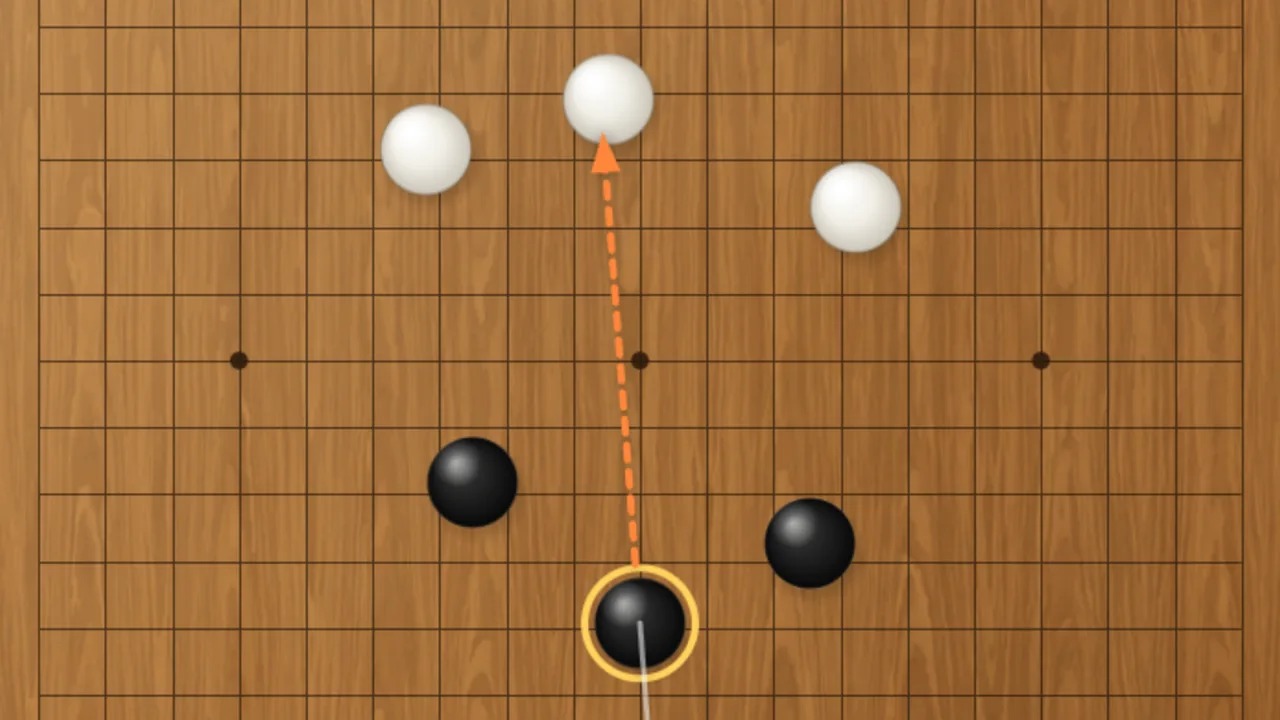
Power starts at 3% and reaches 100% when you pull about 3.6 units, roughly a third of the board. A flicked stone leaves at 1.2 plus 9.8 times the power and slows at a constant rate. A stone that hits nothing slides about 9.4 units at 55%, most of the board, and 26 units at full power. The arrow shows direction and gets longer with power, but its length is not the distance the stone will travel.
With a keyboard, each turn starts with your first stone selected, aimed straight ahead at 55%. Q and E switch stones, Left and Right turn the aim by 0.02 radians (0.004 with Shift), Up and Down change power by 2%, and Space or Enter flicks. On a gamepad, LB and RB switch stones, the left stick aims and sets power, and A flicks.
What happens when stones collide
All stones weigh the same, and the collision restitution is 0.88. In practice a full, straight hit passes 94% of your stone’s speed to the stone it hits, and your stone stops almost where the contact happened. An off-centre hit sends the target along the line between the two centres, while your stone keeps the sideways part of its speed and carries on. That sideways part is how your own stone ends up off the board.
Three numbers from the opening position
These come from the game’s own simulation with the default five stones per side, flicking Black’s middle stone at White’s:
- Straight at the opposite stone, about 52.5% is the least that knocks it off. Below that it stays on. Above it, your stone stops about one stone width from where the target was.
- A straight shot from your row that misses everything stays on at 54% and slides off the far edge at 55%. Since 55% is the keyboard default, a missed default shot costs you the stone.
- Aiming 0.08 radians (about 4.6 degrees) off the centre line at 80% sent both stones off. At 100% the same angle also took a second White stone. At 0.095 radians, a thinner hit, only Black’s stone fell.
Edges, rows and safe shots
Stones near the rim need much less power, but the centre still has to cross the edge. In a test with a White stone 0.54 units inside the edge and Black 4 units away, 30% pushed it to within 0.12 of the edge and it stayed; 35% knocked it off.
Rows matter with six or more stones. Straight shots from the back row can run into your own front row (with ten stones, every back-row stone has one directly in front of it), and the keyboard’s default stone is in the back row. Switch to a front-row stone with Q or E, or turn the aim before flicking.
Safe shots share two things: they are straight, so your stone stops on contact, and they run away from the nearest edge, so a miss slides toward open board.
How the game ends
You win when every stone of the other side has left the board. If the last stones of both sides fall on the same shot, the game is a draw. A match also stops after 100 turns, and then the side with more stones left wins, with equal counts a draw; the result card says “After 100 turns, stones left decide” and shows the count, such as “Stones left · Black 2 : 1 White”. Every turn counts, including a turn that ran out of time online.
How the computer chooses a shot
The computer pairs each of its stones with your stones, ranks the pairs by distance plus how far your stone is from the edge, and keeps the best pairs: 5 on Easy, 9 on Normal and 14 on Hard. For each pair it tries a straight hit and two cut hits at 50%, 72% and 95% power, simulates every one with the real physics, and scores the result: plus 10 for each of your stones that falls, minus 13 for each of its own, and a little for keeping its stones away from the rim. A one-for-one trade therefore scores below zero, and it prefers shots where its own stone stays on. Then:
- Easy picks at random among the best 45% of its candidates and misses by up to 0.07 radians and 16% of the power.
- Normal picks among the best 15%, with errors up to 0.028 radians and 7%.
- Hard always takes the best candidate, with errors up to 0.009 radians and 2.5%.
Common mistakes and why they happen
Most stones lost in a first game go in a few predictable ways.
- Flicking hard to be sure. A straight hit already stops your stone; extra power only matters when you miss, and then it sends your stone off the far edge.
- Shaving the target. A thin hit moves the target a little and lets your stone keep most of its speed.
- Pushing a rim stone to the rim. Its centre has to cross the edge, so a push that is just short leaves it sitting there for the opponent to use.
- Forgetting your own front row. With six or more stones, back-row shots can hit your own stones first.
- Leaving a stone near the edge in line with an opposing stone. The computer ranks targets by closeness and by how near they are to the edge.
Your first games, alone or with friends
Start with Play the computer on Easy and five stones. You are Black and flick first; Play again swaps who opens. Games against the computer and on one device have no turn timer and pause when you switch tabs. Two on one device supports 1 : 1 or 2 : 2 on one screen.
To play online, choose Invite friends · online, pick 1 : 1 or 2 : 2 and the number of stones, and create a room. The lobby shows a four-character code with Copy link and Share buttons; codes leave out I, L, O, 1 and 0. A friend opens the link or enters the code under “Got an invite code?” and presses Join. Seats fill in arrival order (the host is Black 1, then White 1, Black 2, White 2), and when the room is full a three-second countdown starts the game. The player on White sees the board turned around, with their own stones at the bottom.
Online turns last 30 seconds; if time runs out, “Time ran out, turn passed” appears and play moves on without costing a stone. In 2:2 the order is Black 1, White 1, Black 2, White 2, and partners flick from the same set of stones. You can send five quick reactions (Hi, Nice, Wow, Oops, GG). Leaving mid-game counts as a forfeit in 1:1; in 2:2 a departed player’s turns are skipped, and if both partners leave, the other team wins. A rematch needs every player to press Play again, and the opening seat moves on each time.
Play it yourself
Alkkagi
Flick Go stones off a wooden board. Play the computer, share one device, or invite friends by link or 4-character code for 1v1 and 2v2.