What one run checks
Pressing Run does not play a scripted animation. The game builds the board from the parts you placed and runs four simulations in a fixed order: light first, then electricity, then motion and chemistry. The order matters on the Nature boards, because a lit solar cell becomes a power source for the circuit, and a circuit that is on can then drive an electromagnet, a heater or the electrodes in a flask.
A run passes only when nothing went wrong and every goal on the board is met. Things that fail a run on their own, even if every goal looks satisfied, are a short circuit, a burnt-out bulb or LED, any light reaching an eye, and any spill from an open pipe end. The same code runs on the server, which is why your result is the same in Solo and in a race.
Stars count only the parts you placed. At or under the stage’s target you get three, up to two parts over gets two, and anything else that works gets one. Your best record keeps the most stars first and then the fewest parts. The first experiment of each chapter is always open, and each later one opens when the one before it has at least one star.
Light: colours are bits, and the match must be exact
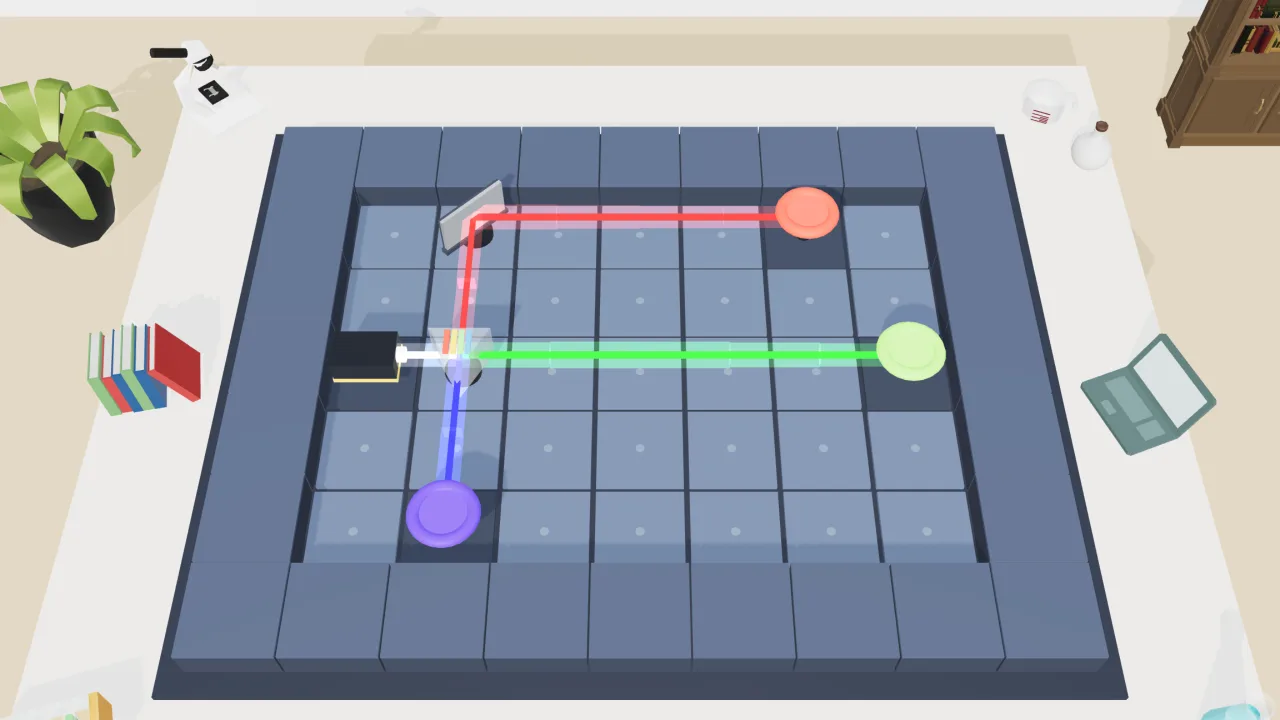
Each beam carries some mix of red, green and blue. White is all three, yellow is red and green, cyan is green and blue, magenta is red and blue. A light sensor passes only if the colours that reach it, from every direction combined, are exactly its ring colour. A white beam on a yellow sensor fails, and so does yellow plus a stray blue beam.
A filter keeps only the colours it shares with the beam. A cyan filter turns white into cyan, turns yellow into green, and stops red completely. A prism splits a beam into its parts: red turns to one side, green goes straight, blue turns to the other side, and rotating the prism swaps the two sides. A beam splitter sends one copy straight on and one copy sideways, and two beams entering it from different sides leave together.
Beams pass straight over flat parts lying on the board, such as wires, switches, resistors and pipes, so on the mixed boards you don’t need to route light around your wiring. Batteries, bulbs and blocks stop it. Eyes fail the run if any colour reaches them, which is why Filter Out the Blue needs a yellow filter: it strips the blue so the eye behind the prism stays safe.
Electricity in numbers
The circuit is solved properly, not by checking whether pieces touch. A battery is 1 V with a very small internal resistance (0.02 Ω), a bulb is 1 Ω and a resistor 2 Ω. A bulb is off below 0.2 A, dim from 0.2 A, bright from 0.7 A, and burnt out above 1.5 A. More than 3 A through a battery counts as a short circuit. Worked out from those values and checked against the stage solutions (wire pieces add a tiny resistance, so real boards read slightly lower):
- One battery, one bulb: a little under 1 A, bright.
- Two bulbs in series: about 0.5 A each, both dim.
- Two bulbs on separate branches: a little over 0.9 A each, both bright.
- Two batteries in series on one bulb: about 1.9 A, burnt out. Add the 2 Ω resistor and it drops to about 0.65 A, dim.
- Four bulbs in parallel on one battery: each bulb would be bright, but the battery carries about 3.7 A, which is a short.
- A lit solar cell is a 1 V source with 0.5 Ω inside, so a single bulb on it gets about 0.67 A: dim, not bright.
Goals that say “on”, and the switch stages
Read each goal word carefully. A goal of “on” is met by a dim or a bright bulb; only “bright” needs 0.7 A. That is what makes the NOT stage work: a switch placed across the bulb skips it when closed, and the resistor in the loop keeps that bypass from becoming a short, while with the switch open the bulb still glows dimly, which counts as on.
Stages with lettered switches are solved once for every combination of switches, and the bulb must match the logic in each case. Series switches give AND, parallel switches give OR. When a case fails, the message names it in the form “With (switch states), (bulb) is (state)”, so you know which combination to fix. LEDs and diodes pass current one way only, and a motor’s spin direction follows the direction of the current.
Motion: the wall board
Motion boards are seen from the side, with gravity pulling down. Balls gain speed falling and lose it climbing, and a ramp turns that speed sideways. A spring sends a falling ball back up, a sponge stops a ball dead, a mat slows a rolling ball sharply, and a conveyor adds speed in the direction of its arrow. Magnets pull only steel balls, so glass and wooden balls roll past them; an electromagnet pulls only while its circuit is on.
Two goal types need attention. A bell rings only when the ball hits it fast enough, and the failure message gives the speed it needed. A cup can ask for particular balls, in which case exactly those balls must land in it and no others. The run ends when nothing on the board is moving any more.
Chemistry: counting units
Reagents move as single units along pipes, one tile at a time, and the number on a bottle is how many units it holds. A bottle opens only when a pipe or flask faces it, so leaving a bottle unconnected is a valid choice and often the right one. Any open pipe end spills and fails the run, and the crossover pipe lets two flows cross without mixing.
Reactions use real balanced equations: hydrochloric acid and sodium hydroxide one to one, two hydrogen to one oxygen, two hydrochloric acid to one calcium carbonate. Some need a condition: hydrogen burning and heating limestone need a burner or a working heater next to the flask, hydrogen peroxide needs manganese dioxide, and splitting water needs current through the flask’s electrodes.
pH is decided by what is left over. Any strong acid left makes the flask acidic; otherwise any strong base makes it basic; then a leftover weak acid gives weakly acidic and a leftover weak base weakly basic. Only when none remain is it neutral, shown green with an indicator. Some flasks also fail if a named substance is left over, so pour exact amounts, not extra.
Nature: where the chapters meet
Nature boards chain the other four. A solar cell gives power only while light reaches it, in any colour. A plant needs both red and blue light, and green does nothing for it, which is the point of Why Leaves Are Green. Some plants also need a set number of water units by pipe, and the failure line shows the count, for example “Not enough water (1/2)”. On the solar hydrogen and solar electromagnet boards, check each link in turn: is the cell lit, is the circuit closed, and is the part it powers actually on?
What the hint button actually does
A hint compares your board with the stage’s reference solution and points to one action: place a named part on a marked tile, rotate a marked part, or remove a marked part first. Hints never cost stars; the result card only shows how many you used. If your parts already match the reference, it says “Everything is already in place — run it!”
Because hints follow one particular solution, they will ask you to remove parts from a different arrangement even if yours could also work. If you want to finish your own idea, run it first and read the failure line before asking for a hint. Hints are switched off in races.
Races, points and bots
The host picks one, three or five rounds, 90, 150 or 240 seconds a round, and one chapter or all five. Race stages are drawn only from difficulty 2 to 4, so the easiest difficulty-1 stages and the five difficulty-5 finales never appear. Your board is checked on the server; after a wrong answer you can submit again after 1.5 seconds. Once someone solves a round, the others have 45 more seconds.
Places earn 10, 7, 5 and 4 points, then 3 for any later place, plus 2 for a three-star solution. A three-star second place earns 9, one point short of a first place without three stars. The match ranking uses total points, then rounds solved, then total solving time.
Bots don’t actually build the board; they submit the reference solution after a set time. In seconds that is 55 + 16 × difficulty + 4 × parts for Easy, 30 + 10 × difficulty + 4 × parts for Normal, and 14 + 6 × difficulty + 2 × parts for Hard, each multiplied by a random 0.75 to 1.25. On a difficulty-3 stage with a two-part reference, that is roughly 83 to 139 seconds for Easy, 51 to 85 for Normal and 27 to 45 for Hard. A bot whose time is longer than the round never solves it, so Easy bots often miss 90-second rounds.
Play it yourself
EUREKA LAB
A 3D science puzzle lab. Place mirrors, wires, ramps and pipes to solve 50 experiments in light, electricity, motion, chemistry and nature, or race up to eight players online to solve them first. Touch and gamepad supported.