One cast, start to finish
After you cast, a fish bites 1.1 to 2.7 seconds later, usually after two light taps on the float. Start reeling within 0.9 seconds of the bite and you get “Hook set!”, which matters later: a set hook stays on longer when the line goes slack. Every hooked fish then opens with a run away from you.
The fish starts at a little over half the line’s length from you. It is caught when you bring it almost all the way in, and it escapes if it reaches the full length. Solo fishing lasts 90 seconds. The clock does not start until your first cast and stops while paused, but it keeps running while you wait for bites and while the catch card is showing, so cast again as soon as you can.
What the tension gauge is made of
Tension is the fish’s pull, plus your reeling, plus a penalty when the rod points away from the fish. Holding reel adds a lot on top of a hard-pulling fish, and dragging the rod toward the fish keeps the angle penalty small while also letting you wind faster. When tension climbs past the drag setting, line slips off the spool and only part of the extra load reaches the line. That slip is what saves you during a run, but it also gives the fish distance.
Three timers end a fight:
- Snap: tension stays near the top of the gauge for 0.3 seconds.
- Slack: after the first 2.5 seconds, tension sits almost at zero for about 2.7 seconds with a set hook, or 2.1 seconds without one.
- Thrown hook: during a jump, tension stays low for 0.6 seconds (0.5 without a set hook). This is why the jump label says “Jump! Keep reeling”.
Read the fish, not just the gauge
A hooked fish switches between five behaviours, and the label above the gauge tells you which one: Taking a breath, Pulling hard, Running! Ease off, Shaking its head, and Jump! Keep reeling. A fresh fish runs more and rests less; as its stamina drains, rests get longer. Loading the line drains stamina, and every run against the drag drains it faster, so letting a big fish run is how you tire it.
Species fight differently. Glacier Trout jump most often, followed by Frost Char and Amber Perch. Lotus Carp, Moon Koi and Thunder Eel never jump, and the Golden Ray almost never does. The Thunder Eel shakes its head hardest. The Golden Ray, Aurora Sturgeon and Moon Koi make the strongest runs.
Mistakes that lose fish
Each of these follows directly from the timers above:
- Waiting to reel after the bite. Miss the 0.9-second window and the hook stays loose for the whole fight, so slack and jumps throw it sooner.
- Holding reel through the opening run of a legendary or mythic fish. Its pull plus full reeling carries the tension past the snapping point; in the test below, every line that snapped under constant reeling broke during that run, inside the first 3 seconds.
- Letting go when the fish jumps. That is the one moment when releasing is wrong.
- Leaving the rod pointed where the fish was. It moves side to side, and an angle away from it both raises tension and slows winding.
Measured: easing off versus holding the reel
I ran every species through the game’s own fight code automatically, 400 times each, with two simple strategies and starting gear. “Ease off” reels until the gauge passes about 80% or line starts slipping, waits until it falls below about 60%, and always reels during jumps. “Hold” never lets go. The automated player reacts instantly, so real hands will do a little worse:
- Common: ease off 100% landed in about 10 s; hold 100% in about 9 s.
- Rare: ease off 94% in about 15 s; hold 84%, with 7% snapped.
- Legendary: ease off 62% in about 19 s; hold 16%, with 74% snapped.
- Mythic: ease off 34% in about 21 s; hold 0%, every line snapped.
- With rod and reel both at level 4, easing off landed 100% of legendaries in about 7 s and 96% of mythics in about 9 s.
Gear: what each level changes
Gear needs a GameNow account, since coins and upgrades are saved on the server. Each item has four levels.
- Rod (80, 180, 360, 620 coins): lowers tension a little, raises the drag point and the snapping point, and opens new places. Storm Cove needs rod level 2 and Frost Lake level 3.
- Reel (70, 160, 320, 560): winds faster; at level 4 almost twice as fast as at level 0.
- Bait (60, 140, 280, 500): each level makes rare, legendary and mythic fish 35% more likely relative to commons. In the current code the boost stops at level 3, so the fourth bait upgrade does not change the odds.
- A sensible order is rod to level 2 for Storm Cove, then reel, then rod to 3 for Frost Lake.
When rare fish bite
Each place has its weather for the whole day, set by the date in UTC. Reed Lake and Storm Cove are rainy on about one day in three; Frost Lake is snowy on about two days in three. Night runs from 18:00 to 06:00 UTC. The chip at the top of the screen shows the current weather and whether it is day or night. A fish whose preferred weather or time matches is 2.6 times (weather) or 2.2 times (night) more likely, and one that doesn’t match is about a third as likely. Odds per bite, from the game’s weights:
- Moon Koi (Reed Lake, night): 1.6% on a clear day, 9.4% on a clear night, 16.6% with bait level 3.
- Lotus Carp (Reed Lake, rain) and Thunder Eel (Storm Cove, rain): about 6% when dry, about 30% in rain, over 40% in rain with bait 3.
- Golden Ray (Storm Cove, night): the rarest fish, at most 3.2%, on a clear night with bait 3.
- Aurora Sturgeon (Frost Lake, snow and night): 0.6% on a clear day, 16.6% on a snowy night, 23.7% with bait 3.
Events on a bite
About one bite in four carries an event, announced as it bites. “Giant fish!” (8%) is a boss: it pulls harder and pays double coins. “Golden treasure chance!” (5%) adds 65 coins to the catch. “Timing chance!” (12%) opens a 2.7-second window 4 to 9 seconds into the fight, and again every 12 to 20 seconds; pressing “Now! Pull” (F on a keyboard) in that window drops the tension and pulls the fish closer.
Coins, sizes and the field guide
A catch pays 12 coins for a common, 28 for a rare, 85 for a legendary and 250 for a mythic, plus up to 60% more for size. Sizes lean small: on average a fish lands at about 38% of its species’ size range, about 8% reach the top quarter, and only about 1% the top tenth, so a new personal best near the maximum is genuinely rare. Catching every species in a place earns its emblem and 120 coins, once.
Tournaments
Online tournaments need an account, last 180 seconds on a clock shared by the room, and rank players by the total length of their catches. Up to eight can join, and there is no pause. Joining the public lake puts you in an open room with space and more than 20 seconds left.
Each player fishes the place they chose, so gear matters here. Average catches are about 15 cm for a Reed Minnow and 33 cm for an Amber Perch, but 54 cm for a Glacier Trout, the same as an average Moon Koi. With a level-3 rod, Frost Lake’s common Glacier Trout scores as much on average as Reed Lake’s legendary, and lands far more reliably.
Play it yourself
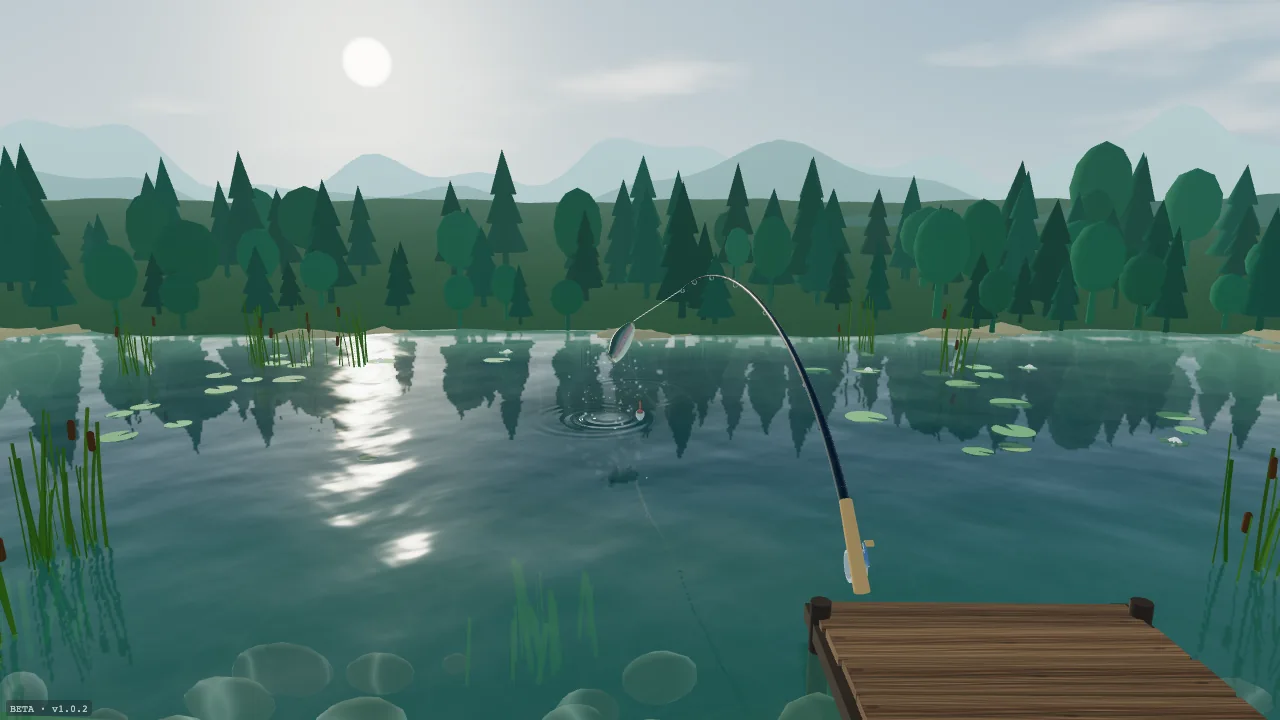
MOONLAKE
Fish a moonlit 3D lake. Manage line tension, collect 12 fish, upgrade your gear and compete online with up to eight friends.