Who pays for a collision
In this duel a crash costs 100 HP, and only the snake whose head hits something pays. If your rival runs into the side of your body, you lose nothing. That single rule is why blocking is the main attack: you do not hit the other snake, you put your body where its head is about to go.
Both snakes move at the same instant, six steps a second, and the game decides each step on the board as it stood before anyone moved. Your own body always blocks you, even while you are blinking after a respawn. The rival's body blocks you only when neither snake is blinking. A tail cell that is being vacated this step is open, unless that snake is still growing from a meal.
A cut needs a two-cell lead
The classic attack is to run alongside the rival, get ahead, and turn across its path. I set up that exact situation in the game's rules code, with both snakes heading up in neighbouring columns, and turned across at different leads:
- Level heads: you turn into the rival's head cell and crash. You pay 100, it pays nothing.
- One cell ahead: both heads enter the same cell on the same step. That is a head-on, and both snakes pay 100.
- Two cells ahead: your body now lies across the cell in front of the rival. It must turn on the very next step, about 1/6 of a second after it sees your turn, or crash alone.
- Three cells ahead: the same block, but the rival gets one more step to react.
Head-ons are a trade, not an attack
A head-on costs both snakes the same 100 HP (150 each in the Finale), so it never changes the HP gap. When you are ahead and the clock is short, an equal trade keeps your lead while removing time; when you are behind, it only brings both of you closer to zero together. If both snakes reach zero on the same step, the match is a draw.
After two snakes crash on the same step, both come back together 1.2 seconds later at the starting spots, facing each other in the middle column. If neither turns, the heads meet again seven steps later, so the first turn after a double respawn decides who gets the open side of the board.
How the AI chooses its moves
The practice AI does not try to block you. Each step it lists the directions that do not crash at once, counts how many open cells lie beyond each, and treats a direction as safe if the count reaches its own length plus two. Among safe directions it takes the one closest to the nearest food by grid distance, golden or not. Your whole current body counts as wall to it, but it does not predict where your head goes next, so it will walk into a head-on.
The levels differ in how far the AI counts and how often it slips:
- Easy counts at most 10 cells, picks a random safe direction 6% of the time and never boosts. Once it is nine cells or longer, no direction can show length plus two, so every direction looks equally open to it and it simply heads for food.
- Normal counts up to 45 cells, slips 2% of the time, and boosts when its bar is at 60 or more with at least six free cells straight ahead.
- Hard counts the whole board, never slips and boosts the same way as Normal.
Trapping each level
Because the AI turns away from any wall it can see, a single cut rarely kills it; it crashes when every direction leads into too little space. On Easy, that means a pocket: run your body across the mouth of an area, and once the AI is long it cannot tell an enclosed area from open board. On Normal the same works for pockets larger than 45 cells, three full rows of the 15-cell-wide board.
Against Hard, look for moments when it has to choose between a short dead end and your head. Since it ignores your next move, a cut with a two-cell lead into the lane it is heading for still forces it to turn, and turns near walls run out of room quickly.
Using boost to set up a cut
Each boosted step moves you two cells while a normal snake moves one, so two boosted steps give you exactly the two-cell lead a cut needs. Starting a boost takes 20 of the 100-point bar, and each boosted step costs 12, so 20 buys one boosted step and you need at least 24 for two. The bar refills 3 per step when you are not boosting, and each food refunds 15.
Both cells of a boosted step are checked separately, so you cannot hop over a body, and you cannot turn between them. Boost along open lanes to get ahead, then turn with the boost released.
Turning precisely
A turn applies on the next step, and you can queue up to two. In Solo the turn aid, on by default, shows your queued turns as arrows above your head, and a refused turn appears in red with the reason: “reverse”, “same direction” or “queue full · wait”. Online, a turn that reaches the server less than 70 ms before a step lands one step later.
On a touch screen, Touch settings in Solo adjust the swipe distance (12, 18 or 30 pixels), the hold time before boost (350, 500 or 700 ms), and can switch to a separate Boost button. On a keyboard, Shift boosts; on a controller, the stick or D-pad turns and A boosts.
Your first rounds, step by step
A short plan for the first few Solo rounds against Easy:
- The first time, the rules appear before play; press “Try it”. After the 3-2-1 count both snakes start in the middle column heading at each other, so turn sideways early.
- Eat the nearest food and watch the line at the top left, “Next food ×1.5 · 3s”, to keep a chain going.
- When Easy grows past eight cells, start closing pockets around it instead of racing it for food.
- Practise the two-cell cut on purpose; the star “Make the rival crash into you” confirms when it worked.
The Finale changes the arithmetic
The Finale starts on the step after either snake falls to 400 HP or less, or with 45 seconds left: five foods instead of three, more golden apples, food damage at 70% and crashes at 150 HP. A golden apple without a chain now deals 11, so one forced crash is worth more than a dozen golden apples. From here a successful cut matters more than any meal, and a risky lane matters more than any food.
Stars, Today's snake and online play
Results award up to three stars: win, crash two times or fewer, and make the rival crash into you at least once. In Solo they are counted per level.
Today's snake uses the same rules, Finale included, against the Normal AI on a board seeded the same for everyone; your score is the HP you have left. Every meal the AI takes lowers that score, so trapping it early pays twice. Online play against a person (Find opponent, a challenge from the player list or an invite code) has no pause and the 70 ms turn rule above, and a human opponent, unlike the AI, will try to cut you.
Common mistakes
Four habits that cost HP, and the rule behind each:
- Cutting from level or one cell ahead: you crash, or both of you do.
- Boosting into a corner: you cannot turn between the two cells of a boosted step.
- Assuming the rival's body is solid right after a crash: while either snake blinks, you pass through each other, so a block set then does nothing.
- Chasing gold along your own tail: a golden apple keeps your tail in place for three steps, so the cell you expected to open stays blocked.
Play it yourself
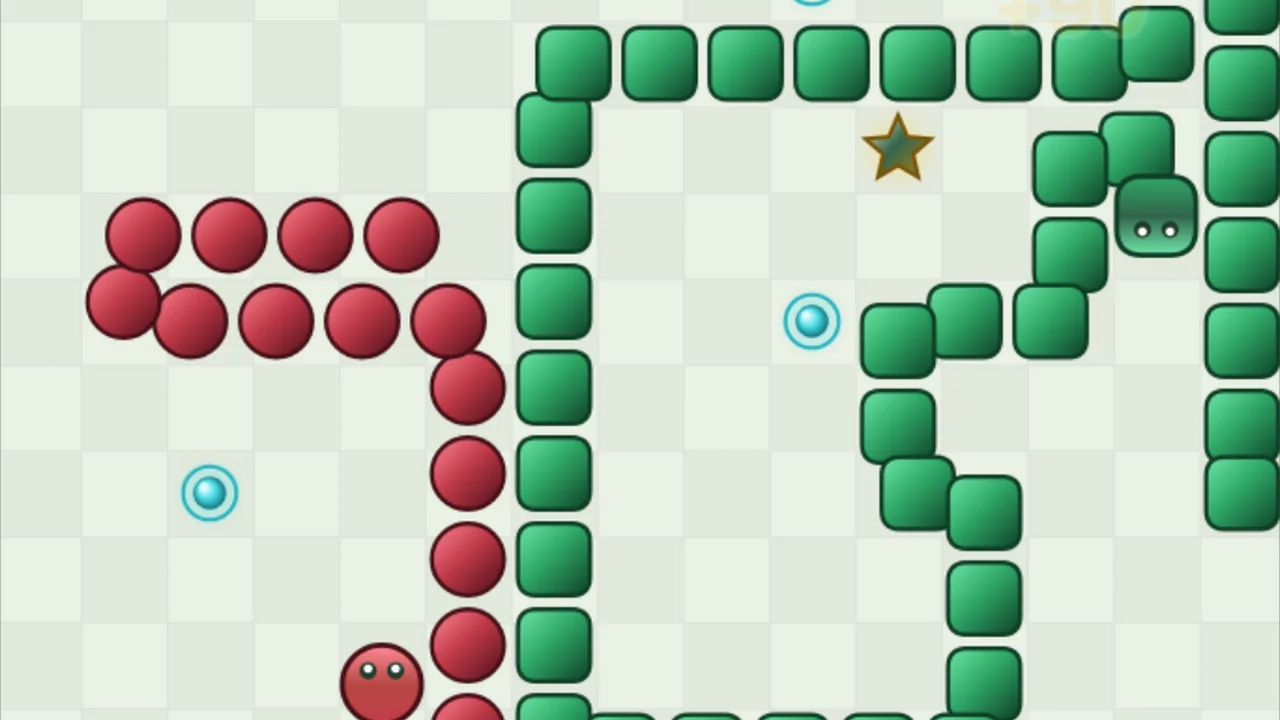
Snake
Eat, grow and avoid collisions. Play solo or challenge another snake in real time.