Rides out, guests in
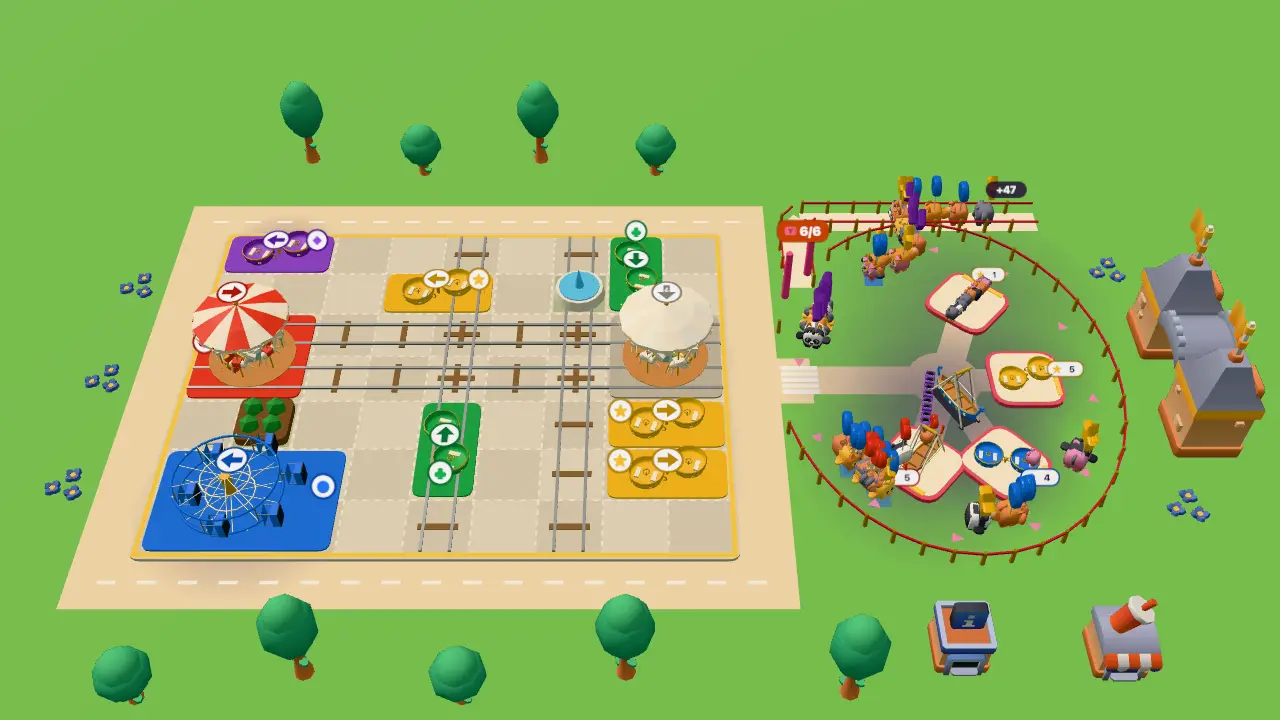
RIDE JAM is a 3D queue puzzle set in an amusement park. The bottom of the screen is a depot packed with rides on trailers, each with an arrow. Tap a ride and it rolls straight off the board in the arrow's direction, but only if every cell from its front edge to the depot's edge is empty. If anything is in the way it lurches forward, bumps, and rolls back; nothing is lost except a moment.
There are five ride types, and their footprint decides how much they block: teacups take 1×2 cells and seat 5, a Viking ship 1×3 and seats 7, a roller coaster 1×4 and seats 12, a carousel 2×2 and seats 10, and a Ferris wheel 2×3 and seats 14. A ride that leaves the depot drives up through a crossing into the round boarding plaza above the depot and parks on one of the four platforms set around it, facing outwards.
Guests wait in a line outside the plaza gate, each holding a balloon. The gate lets in only as many guests as the sign above it shows — 10 in the first levels, 4 in the night area — and those guests circle the walkway around the platforms, always in one direction. A circling guest boards a ride of the same colour with a free seat; if two rides of that colour are parked, the guest takes the one with fewer seats left, so rides fill up and leave instead of all sitting half full. Every time someone boards, the next guest in line walks in. Every balloon colour also has its own shape — heart, circle, star, clover, diamond, moon, flower and drop — and the same symbol is painted on each ride and on the seats-left tag in front of its platform, so colours can be matched without relying on hue alone.
Four platforms are the whole game
When a ride is full it runs once and leaves, and its platform opens again. The park only stops in two ways: every platform is taken and none of the circling guests can board any of the parked rides, or no ride in the depot can move at all. That makes the four platforms the real currency. Sending a ride whose colour is not circling yet is not free; it holds a platform until enough guests of that colour have walked in.
Stars measure exactly that. One star for seating everyone, two for doing it without boosters, three for doing it without boosters while never having more rides parked at once than the level's goal. The goal comes from the solver: it tries the level with one platform, then two, and so on, and the smallest number that still solves it is the minimum. If a person-like robot rarely gets that low, the goal allows one platform more, but never more than that and never below the minimum, so it is always reachable. Using every platform never counts as the goal, unless the minimum already needs them all. The platform dots at the top turn orange the moment you go over it, so you know immediately that this run is now about two stars.
Rush Hour on rails
From level 6 some rides stand on rails painted across the depot. You can drag a rail ride back and forth along its own length into empty cells, the way cars move in the Rush Hour sliding puzzle. Sliding never touches the platforms, so it is the cheap way to open a path: instead of sending the blocker away (and parking it), you push it one or two cells aside.
The rails are not decoration. Of the 55 campaign levels that have rail rides, 22 need more platforms if you never slide, according to the solver run that produced the level table, and 3 of those cannot be solved at all without sliding. The other 33 can be solved with the same minimum either way, but sliding still saves boosters and makes the order easier to find. On a keyboard, hold Shift with an arrow key to slide the selected ride; on a controller, hold X and press a direction.
How a level is built so it can always be solved
Each level is generated from a seed and then checked, never hand-tuned into an unwinnable state. The generator places rides in reverse order of removal. A new ride may only go where it does not overlap anything already placed and where its own path to the edge is clear of those rides, because those are the rides that will still be there when it leaves. Rides placed later can sit in its way; they will be gone by then. The result always has at least one order in which every ride can leave.
The guest line is built by playing that order through a few platforms and, at each step, picking which waiting ride the next guest (or group) wants, using the real boarding rule. A 'streak' setting decides how often the next guest wants the same ride as the last one; early areas use long streaks, later areas short ones, which interleaves colours. The plaza capacity shrinks from area to area too — fewer circling guests means fewer colours to choose from at any moment. Rail rides are then pushed along their rails into positions that block other rides. Because a slide can always be undone, the original solvable layout is still reachable.
Finally a solver — a depth-first search that remembers every depot, plaza, line and platform state it has already ruled out — confirms the level can be cleared with its platforms and finds the minimum platform count. Any candidate it cannot confirm within its search budget is thrown away. The automated test suite replays the solver's moves for all 60 levels through the same rules the browser uses and checks that each one ends with three stars.
Difficulty from a robot that plays like a person
To sort levels by difficulty, a simple robot plays them. It looks at the colours circling the plaza plus the next few groups at the gate, sends a ride of one of those colours if it can, otherwise looks for a single slide that frees such a ride, and otherwise sends anything that can move. For every level the generator makes 40 candidates, lets the robot play each one 80 times, and keeps the one whose failure rate is closest to a planned curve; the fifth level of each area is deliberately a breather and the tenth is the hardest.
Measured again with 300 runs per finished level and averaged per area, the robot seats everyone 93% of the time in area 1, then 79%, 64%, 48% and 39%, and 26% in the night area. It reaches three stars in 51% of runs in area 1 and 12–16% from Ferris Wheel Hill on. The first build felt too easy, so the plaza now has four platforms instead of five, every area's plaza holds two fewer guests, rides seat about 1.2 times as many, and the generator aims a little harder when it picks each level; these numbers were measured after those changes (before it: 100%, 96%, 88%, 76%, 60% and 44%). These are robot numbers, not player statistics; a person who plans ahead does much better, but the ordering tells you where the walls are.
What each area adds
The 60 levels are split into six areas of ten, and each area introduces one new idea so there is something to learn every few minutes.
- Main Gate Plaza (1–10): teacups, Viking ships and coasters on 5×5 to 6×7 depots, a plaza for 8–10 guests; rail rides from level 6.
- Carousel Garden (11–20): the 2×2 carousel, and white rides whose colour is hidden until their path to the edge opens; the plaza holds 7.
- Viking Lake (21–30): flower beds and fountains that never move, and rides under maintenance that open only after a set number of rides have left; the plaza holds 6.
- Ferris Wheel Hill (31–40): the 14-seat Ferris wheel and groups of two or three guests who must ride together, so a ride needs enough free seats for the whole group.
- Coaster Canyon (41–50): everything on 7×9 depots with 11–17 rides, up to 127 guests and a plaza for 5.
- Night Parade (51–60): six colours, string lights and a plaza for only 4.
Boosters, and why the brush changes the back of the line
Campaign levels allow three boosters. The crane lifts any depot ride (except one under maintenance) straight to a platform, even if it is blocked. The extra platform opens one more platform for the rest of the round, once per round, in the empty fifth spot. The paint brush repaints a parked ride in the colour of the guest who has waited longest in the plaza. Because each colour's seats must always equal that colour's guests, the brush also changes the balloons of as many guests as the ride has free seats, from the old colour to the new one — starting from the back of the line outside the gate; the screen tells you how many changed.
You start with two of each and earn one more the first time you three-star a level. When the line stops, the game offers to continue with a booster you still have, or to start over. Boosters cost the two- and three-star goals for that run, and they are switched off in Today's park and in friend challenges so those results stay comparable.
Today's park and challenge links
Today's park is generated from the date, with the day changing at midnight Korea time, so everyone in the world gets the same board: a 7×9 depot with five colours, three rail rides, four platforms and a plaza for five guests, usually with a few white rides, one maintenance lock and some groups, plus a fountain and a flower bed. The generator keeps the first candidate whose robot failure rate is between 42% and 85%. If you are signed in, your move list is sent to the server, which replays it with the same rules before it enters the ranking; the ranking orders by stars, then peak platforms, then time.
After any clear you can send a challenge link. It carries only the level (or day), your time in seconds, your peak platforms and your stars, never a name. Your friend opens straight into the same park without menus, sees your record first, and gets a side-by-side result at the end with a button to send their own record back. Messenger previews read the link on the server, so the preview card already says which level and what time to beat.
Habits that help
- Watch who is circling. The colours already in the plaza decide which ride you can park now; the gate sign tells you how many more can come in.
- Keep one platform free whenever you can. Five parked rides with no matching guest in the plaza is the only way to get stuck while rides can still move.
- Slide before you send. If a rail ride is only in the way, a slide opens the path for free.
- Open white rides early when their path is cheap to clear; knowing their colour changes the plan.
- Watch group sizes. A group of three will not split across two rides with two seats each.
- Count maintenance numbers down: a locked ride that needs three departures will not help you before then.
Play it yourself
RIDE JAM
Pull out rides, clear the park queue. Free carousels, Viking ships and coasters from a jammed depot, seat guests with matching balloons, slide rides on rails Rush Hour-style, and beat 60 levels, a daily park and your friends' challenge links.