Move, and the street turns your colour
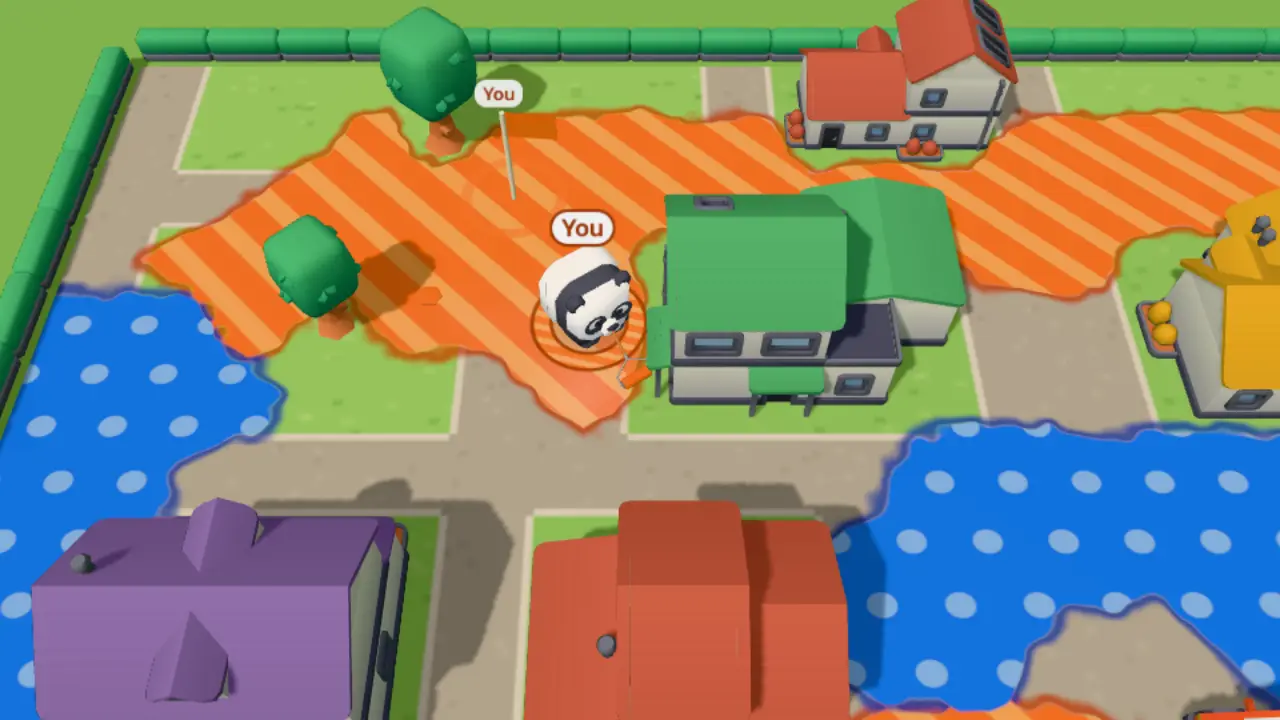
PAINT TOWN is a two-minute team game for 2v2, 3v3 or 4v4. Each player is a cube-shaped animal pushing a paint roller through a small suburban neighbourhood. There is no attack button: every tile within 1.2 tiles of your animal takes your team's colour as you walk, so a moving player leaves a stripe about three tiles wide. Walking over the other team's colour takes those tiles back.
The three neighbourhoods are 28 by 36 tiles, with 740 to 764 tiles you can paint once houses, trees, parked cars and the brook are removed. You move 12% faster on your own colour and 16% slower on the other team's, so pushing deep into enemy paint is a real decision rather than a free detour. From the 12th second, paint cans appear in symmetric spots every 15 seconds; grabbing one splashes every tile within 3.2 tiles at once.
Nobody is knocked out. When two rivals bump into each other at speed they bounce apart and spend 0.35 seconds dizzy at half speed, then keep painting. A player who makes a mistake loses a moment, not the rest of the round.
The problem with counting at the buzzer
The obvious rule for a paint game is to measure the map when time runs out. Before shipping I tested that rule against two alternatives with bot-only matches: 200 matches for every combination of the three maps and the three team sizes, 1,800 equal matches in total. For each match I recorded both teams' share of the map every second, then asked each rule who would have won with ten seconds left, with five seconds left and at the end.
With final-area scoring, the winner changed during the last ten seconds in 22% to 46% of matches depending on map and size, about 31% on average. The team that held more ground across the whole two minutes won only 65% of the time on average, and as little as 51% in one combination. In other words, roughly a third of the rounds were decided by whoever repainted last, not by whoever painted better.
Counting every 10 seconds instead
PAINT TOWN tallies the map 12 times, every 10 seconds. At each tally your team gains points equal to the whole-number percentage of paintable tiles it holds at that moment, so holding 34% at a tally is worth 34 points. The team with more points after the 12th tally wins; if the points are level, the tiles held at the end break the tie.
In the same 1,800 matches this rule changed the winner during the last ten seconds in only 3% to 7.5% of matches (5.6% on average), and the winner was the team that held more ground over time in 92% to 97.5% of matches. It did not freeze the result early either: the team trailing at half time still won 17% to 29% of the time. A mixed rule that added the final area twice on top of the tallies landed in between, with 9.7% late flips on average, so I kept the simpler one.
That is why the timer has a yellow ring that fills toward the next tally, and why each tally pops up as +points for both teams. The big bar at the top still shows the current area, because that is what you are changing with every step.
- Final area only: winner changed in the last 10 s in 31% of matches on average
- Tally every 10 s: 5.6% on average, and the better team over time won 94% on average
- Comebacks still happen: teams trailing at half time won about one match in five
What that means when you play
Early ground pays twelve times. A street you paint in the first ten seconds and keep counts in every tally, while a street painted in the last five seconds counts once. Spreading out at the start matters more than chasing the other team.
Watch the ring around the timer. Just before it fills, protecting the area you already hold is worth more than starting a long trip into enemy paint that will only finish after the tally.
The final 20 seconds still matter: the music changes, the clock pulses, and the last tally is a full tally. A paint can grabbed with ten seconds left is still worth taking. What the rule removes is the idea that the last few seconds can erase the first minute and a half.
Expand or reclaim? It depends on the neighbourhood
To see whether one style always wins, I matched a team of bots that weights enemy tiles heavily against a team that prefers empty ground, 200 times on each map. On Sunny Crossroads, a grid of parallel streets around a central plaza, the expanding team won about 80% of matches. On Brook Bridges, where a stream crossed by three bridges splits the town, the reclaiming team won 78.5%. On Playground Park, where teams start in opposite corners and meet in the park, the reclaiming team won 86%.
Neither style is always right, which is the point. A good round often has one player sweeping the empty edge streets while another retakes the alleys the other team keeps walking through.
Is there one corridor that beats everything?
A paint game can collapse into one boring trick, such as running back and forth along the longest street. I tested exactly that: one of three bots on a team was set to shuttle along a single street near the middle while the other two played normally. That team lost all 200 matches on every map, by a margin of 35% to 39% of the total points. Repainting the same stripe adds nothing once it is yours, and the slower speed on enemy paint makes a long shuttle through contested streets even weaker.
Talking without talking
Friends often play without voice chat, so the game has two signals that only your own team sees. An "I've got it" flag marks where you plan to paint. You can place it by tapping a spot on the mini map, or with Q or the X button to drop it six tiles ahead of where you are moving. Each player has one flag and it lasts 25 seconds. "Help!" marks your current spot for six seconds and can be used every three seconds.
Bot teammates read both. When a bot chooses where to go next, it avoids targets within about six tiles of a teammate's flag, and the two nearest bots head to a help call. In an automated test I put a flag on the spot bots chose most often; the number of bots heading there dropped by at least half. Bots also plant their own flags when they set off on a long trip, so you can see which side of town is already covered.
Fair by construction
Each map is drawn once for the bottom half and rotated 180 degrees to make the top half, so both teams get the same streets, houses and paint-can spots, and a test checks that every paintable tile can be reached from the start. One small detail mattered more than expected: when two rival rollers touch the same tile in the same tick, the later one wins. Processing the teams in a fixed order gave one side a small edge, so the order now alternates every tick. Across the nine map and size combinations, the first team now wins between 44.5% and 54% of equal bot matches.
In friend rooms, empty seats are filled by bots, and a player whose connection drops or whose input stops for three seconds is driven by a bot until they come back to the same seat. Your team is never a player short because someone's phone lost signal.
Made with shared assets
The houses, cars, trees and cube animals are Kenney's CC0 models from the GameNow shared asset library, with roof colours tinted per house. The roller, paint can and festival decorations were added to that library as a new CC0 pack. The music is by Kevin MacLeod (incompetech.com) under Creative Commons Attribution 4.0, and the full credits are in the game.
Play it yourself
PAINT TOWN
Paint the town in your team's colour. Two-minute 2v2, 3v3 and 4v4 turf battles — play bots right away or invite friends with one link.