How a match is decided
A match is first to two round wins. Each round lasts 60 seconds, and the fighters start it 360 pixels apart in the middle of the stage. A round ends at once with a K.O.; if both fighters drop in the same frame, nobody gets the round.
When the timer reaches zero, the fighter with more health points takes the round, and equal health means a drawn round and another round. The comparison is in raw points, not bar length, and that matters because the seven fighters start with different health. Otto at 460 of 1,150 beats Mira at 410 of 820, even though his bar is shorter. The HUD prints each fighter's health as “current / maximum”, so read the numbers rather than the bars when the clock is low.
The seven fighters in numbers
Every fighter uses the same buttons and the same combo rules; what differs is health, frame speed, damage and reach, plus the super. The values below come straight from the move data. “Jab” is the first hit of the three-hit string, reach is measured from the fighter's centre, and string damage is jab, straight and roundhouse with the game's combo scaling (the third hit at 80%).
- Bruno (MMA): 1,000 health. Jab lands on frame 5 and reaches 66 px; string 172; walks 204 px a second. Every multiplier is 1; he is the yardstick the others are tuned against.
- Rico (boxing): 880 health. Jab frame 4, 67 px; string 124; walks 276 px a second, and his dash lasts 10 frames, the shortest with Mira's.
- Otto (kung fu): 1,150 health, the most. Jab frame 6, 70 px; string 186; walks 174 px a second, the slowest.
- Zane (Muay Thai): 960 health. Jab frame 5 but only 58 px, the shortest; string 220, the highest; walks 186 px a second.
- Elias (savate): 940 health. Jab frame 5, 76 px, the longest; his sweep reaches 111 px; string 155; walks 222 px a second.
- Mira (karate): 820 health, the least. Jab frame 3, the fastest; 65 px; string 113, the lowest; walks 300 px a second.
- Kai (taekwondo): 980 health. Jab frame 5, 66 px; string 164; walks 228 px a second. Slightly faster than Bruno with slightly less damage.
Reading those numbers
Speed, power and reach were set so that no fighter leads on all three. Zane's string takes 22% of Bruno's health and Mira's 11%, but Mira's jab arrives two frames before Zane's and she walks at more than one and a half times his speed. Elias's jab reaches 18 px further than Zane's, so in a fight between them Elias can hit from distances where Zane must first step in.
Recovery scales with speed too. Bruno's roundhouse occupies 34 frames, more than half a second; Mira's takes 23 and Otto's 40. A slow fighter that misses is open for longer, which is why the game's coach line after a whiff tells you to adjust your distance.
Which fighter to learn first
Start with Bruno. The tutorial puts you in his shoes, every one of his values is the baseline, and his 1,000 health gives you room for mistakes. Kai, whose description calls him even-handed, is a natural second: almost the same game, a little quicker.
Pick Elias when you want to practise spacing, since his long reach rewards standing just outside the opponent's. Leave Mira and Rico for later: they have the least health and the least damage per hit, and their speed pays off only once you can punish openings. Zane and Otto suit a patient style: Zane has to get inside his short reach, and Otto is slow but can afford to trade hits.
Your first match, step by step
A first session that builds from the tutorial to a real fight:
- On the first visit a window offers the tutorial. Take it: seven lessons, from walking to landing a super, with no time limit. A timeline shows when you pressed compared with when you should have.
- Finishing it leads straight into a fight against the Easy AI. After that, pick your fighter and leave AI skill on Auto; your opponent is always the fighter after yours in the list (Bruno meets Rico, Kai meets Bruno).
- In round one, walk in until your jab reaches, press attack, and press again only when the hit connects. Once that works, add Down + attack on the second press for the sweep.
- When the opponent starts an attack, hold guard and keep holding until the hit has landed.
- After the match, read the result screen: one reason for the outcome, one thing to practise next, and your rating change.
How the AI plays
The AI uses the same button inputs you do. When it is farther away than its own jab reach plus a small margin, it walks toward you, pausing now and then. Inside that range it either attacks first or holds its ground, and sometimes steps back to give you room. When it attacks first, a quarter of its openers are crouching kicks, which have to be blocked low.
The levels are set by percentages: how often it attacks first (10 on Easy, 35 on Normal, 55 on Hard), how often it guards (15, 45, 75) and how often it continues a combo after a hit connects (20, 60, 85). Easy is meant as a training partner that rarely hits back while you learn the string.
Auto keeps a rating on this device that starts at 35, on a scale where Easy is 0, Normal 50 and Hard 100, and blends the settings in between. During a match it also shifts by up to 20 points: a little tougher while you lead on health and rounds, a little softer while you trail.
Mistakes that cost first rounds
Four habits that cost rounds, and the rule behind each:
- Pressing attack again after a miss: the string continues only after a hit connects, so a missed jab just leaves you in its recovery.
- Throwing the roundhouse from far away: it takes 34 frames for Bruno, and a miss gives the opponent half a second to hit you.
- Judging the time-up by bar length: the round goes to raw health points.
- Trying a super in the air: it needs one full meter segment and can only start on the ground.
Playing a friend, online and Today's matchup
“Play a friend” puts two players on one keyboard: P1 moves with WASD and uses F, G and H for attack, special and guard; P2 uses the arrows with J, K and L. Each picks any fighter and the set score carries over through rematches. The button appears only on devices with a keyboard.
Online, you pick your fighter in the lobby and press “Find opponent”. The match runs on rollback netcode, so the game predicts the other player's inputs briefly and corrects itself; if a connection drops, the player still connected wins after 15 seconds. There is no rematch button; the next match goes through the lobby.
Today's matchup gives everyone the same pairing for the day against a Normal AI, and scores rounds won and health left in the final round. The fighter is chosen for you, so it is the one mode where knowing all seven pays off.
On a phone
Since 2026-10-13 an upright phone gets a tall stage instead of a request to rotate: the health bars and timer sit in a strip at the top, the fight in the middle, and a control strip below with labelled Move, Attack, Special and Guard. Branches work by keeping your finger on Attack and swiping up, down or forward. On a keyboard, J or Space attacks, K is special and L or Shift guards; Esc pauses a fight against the AI.
Play it yourself
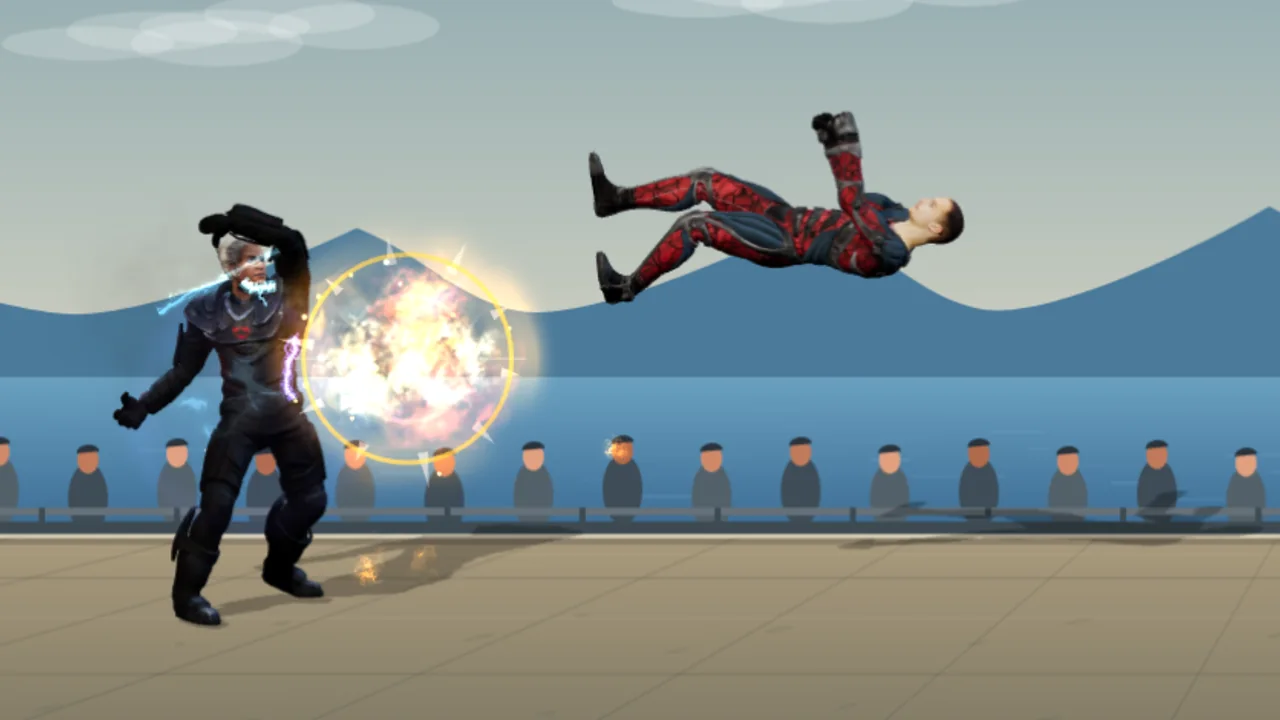
REAL FIGHT
Move, attack and defend in a fighting game with AI practice and real-time 1v1.