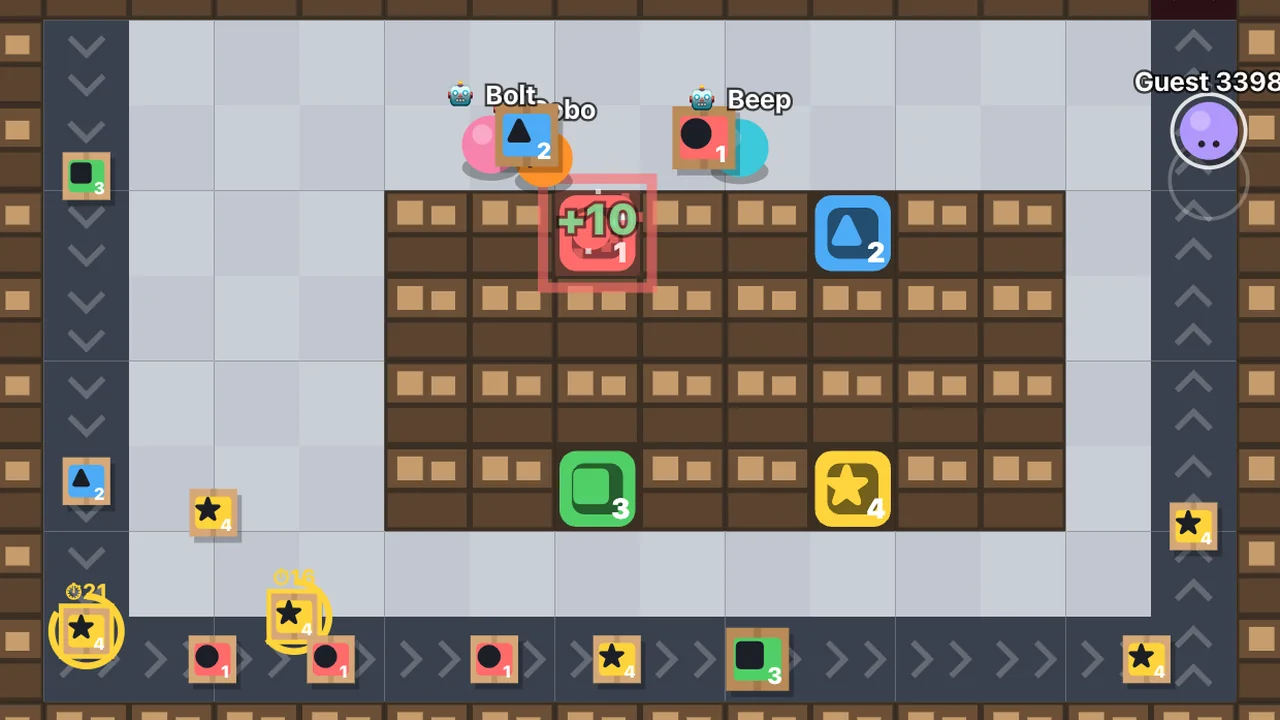
How fast parcels arrive
The server spaces parcels by a base gap that shrinks from 3.4 to 1.8 seconds over the 150-second round, randomised by ±20% and divided by a load factor for team size: 1.7 for two players, 2.3 for three and 2.8 for four, robots included. Rush hour, while the clock reads 1:30 to 1:00, cuts the gap by 30%, and the final rush from 0:25 cuts it by 25%.
For you and one robot that means a parcel about every 2.0 seconds at the start, about every 1.0 to 1.1 seconds during rush hour and every 0.8 to 0.9 seconds in the final rush, roughly 117 parcels in a round if the belt never backs up. Four players see about 192. Each parcel is express 12% of the time, a big box 10%, and normal otherwise. At most 36 parcels can be in play; if the start of a belt is still occupied, the next parcel waits 0.4 seconds.
What each parcel is worth
A correct chute is +10. On top of that come +10 for an express sorted within 25 seconds of appearing, +5 for a big box, +5 for a relay (two or more people held it) and +5 during the final rush. A wrong chute or a parcel that falls off the belt costs 5 and resets your streak. The final score cannot go below 0, and a Today’s Warehouse round needs a score above 0 to be ranked.
- Normal parcel, one carrier: 10. Passed once: 15. Passed in the final rush: 20.
- Big box, passed: 20. It slides only about 1.7 tiles when thrown, so a pass has to be short.
- Express, passed, in the final rush: 30. The 25 seconds start when it appears on the belt, not when you pick it up; after that it scores like a normal parcel.
Hands, feet and throws in numbers
- Pick-up looks for the parcel nearest a point 0.35 tiles in front of you, within 1 tile of it. Standing beside a belt and facing it, you can grab a parcel up to about three quarters of a tile either side of straight ahead.
- You walk at 4.2 tiles a second, 2.8 with a big box. On the co-op maps you can step onto a belt, which pushes you at 1.1 tiles a second its way: faster with it, slower against it.
- A normal throw slides about 4 tiles before stopping and a big box about 1.7. Hitting a plain wall keeps 40% of the speed on that axis, so bank shots die quickly.
- A sliding parcel is caught by the first empty-handed player whose centre it passes within 0.55 tiles, robots included. Your own throw is not caught by you for its first 0.4 seconds.
- Standing right against a chute and facing it, a throw drops the parcel straight in without sliding.
The four co-op maps
Belt times below are for an unblocked parcel from where it appears to the loss bin, at 1.6 tiles a second. The chute order is ● red, ▲ blue, ■ green, ★ yellow.
- Depot: one belt along the top and down the right side, 10.9 seconds long, with all four chutes in the bottom wall, eight rows below the top belt. Only yellow, in the bottom-right corner, is within a throw of the lower end of the side belt, so one player near the belt and one near the chutes, passing across the middle, is the natural split.
- Loop Belt: a 17.2-second belt round the outside and a block in the middle with red and blue on its top face, green and yellow on its bottom face. Green and yellow sit just above the bottom belt with one row of floor between, so they are a short throw away; red and blue face the empty top of the room, away from the belt, and need carrying or a pass. The long belt gives you time to do that.
- Split: two short belts, 3.4 and 4.1 seconds, meeting at a loss bin in the centre row, with chutes in the four corners. The top chutes are three rows above the belts and the bottom ones six rows below, so red and blue are throwable from the belt and green and yellow usually are not.
- Pass-through: a 9.7-second belt behind a counter with openings only at the left end and in the middle. People cannot cross the counter, but thrown parcels slide over it, and a parcel that stops on it can be picked up from either side.
A first round with one robot
Choose Solo · with robots, then Co-op, then one robot. No sign-in is needed, and with no other person in the room, the leave menu or switching windows pauses the round.
The robot never throws into a chute from range: whatever it does not pass to you, it carries to the tile in front of the matching chute. Long throws are your job. Start near the belt, take parcels whose chute is within four tiles and throw them in from where you stand, and stand still with empty hands when you want the robot to pass you one. When a chute is jammed, the robot waits in front of it holding the parcel, so do not hand it that colour.
More robots mean more parcels, not an easier round
Solo can take one, two or three robots, and star lines are set by team size times a map factor, so every robot raises both the parcel rate and the score needed. On Depot one, two and three stars need:
- Two players: 325, 705 and 1,115.
- Three players: 440, 955 and 1,510.
- Four players: 540, 1,165 and 1,835.
Incidents and the final rush
A belt overdrive runs the belt 1.8 times faster for nine seconds, which cuts Depot’s 10.9 seconds to about 6 and Split’s belts to about 2. Stand at the belt end rather than its head for those nine seconds. A pallet spill always lands at least three tiles from every chute and the loss bin, and the parcels slide at most about 1.6 tiles, so none of the six drops straight into a chute or the bin; one that stops on a belt rides it like any other. Grab the express first; its 25 seconds are already running.
From 0:25 every correct sort earns 5 more, but a mistake still costs 5. A correct sort there is worth at least 15 against −5 for a wrong one, so in the last seconds hold a parcel you are unsure of rather than guessing.
Common mistakes and why they cost
- Throwing past a teammate who has empty hands. The first empty-handed player the parcel passes catches it, so a long throw to a far chute can end in the wrong pair of hands.
- Carrying big boxes across the room. You lose a third of your speed, and their short slide means only close throws work.
- Treating express parcels as urgent after the timer runs out. After 25 seconds they are normal parcels.
- Leaving the room while holding a parcel. It is dropped where you stood.
- Reading “rush hour at 60s” as 60 seconds left. It counts from the start; on the countdown clock it runs from 1:30 to 1:00.
Playing with friends and in Versus
Friend rooms and codes work without signing in; Quick Join needs a GameNow account. Today’s Warehouse is ranked only when a signed-in host starts it with no robots and no guests in the room. Role goals scale with team size: Sort means 10, 9 or 8 correct sorts for teams of two, three and four; Carry means 4, 5 or 6 passes a teammate catches; no role means 11, 10 or 9 sorts and passes combined.
Versus uses one 10-cell belt down the middle, 5.9 seconds long, with each team’s chutes on its outer wall about seven tiles away. Parcels come faster for bigger teams (load 1.6, 2.4 and 3 for 1:1, 2:2 and 3:3), the rush-hour speed-up still applies, but there are no incidents, relays or final-rush bonus. Letting a parcel fall costs nothing, while a wrong chute still costs 5, so in Versus a parcel you are unsure about is better left on the belt. A throw that reaches the belt rides it instead of crossing, and players on the other side cannot catch parcels on your floor.
Play it yourself