Two phases: before and after the lever
Every Mulkko stage has two phases, and the rules are different in each. Before anyone steps on the gate lever, there is no water and no clock. You can walk, push and undo for as long as you like, but every step counts as a move. Waiting is not even possible yet: the engine refuses the wait action until the gate is open, so Space does nothing.
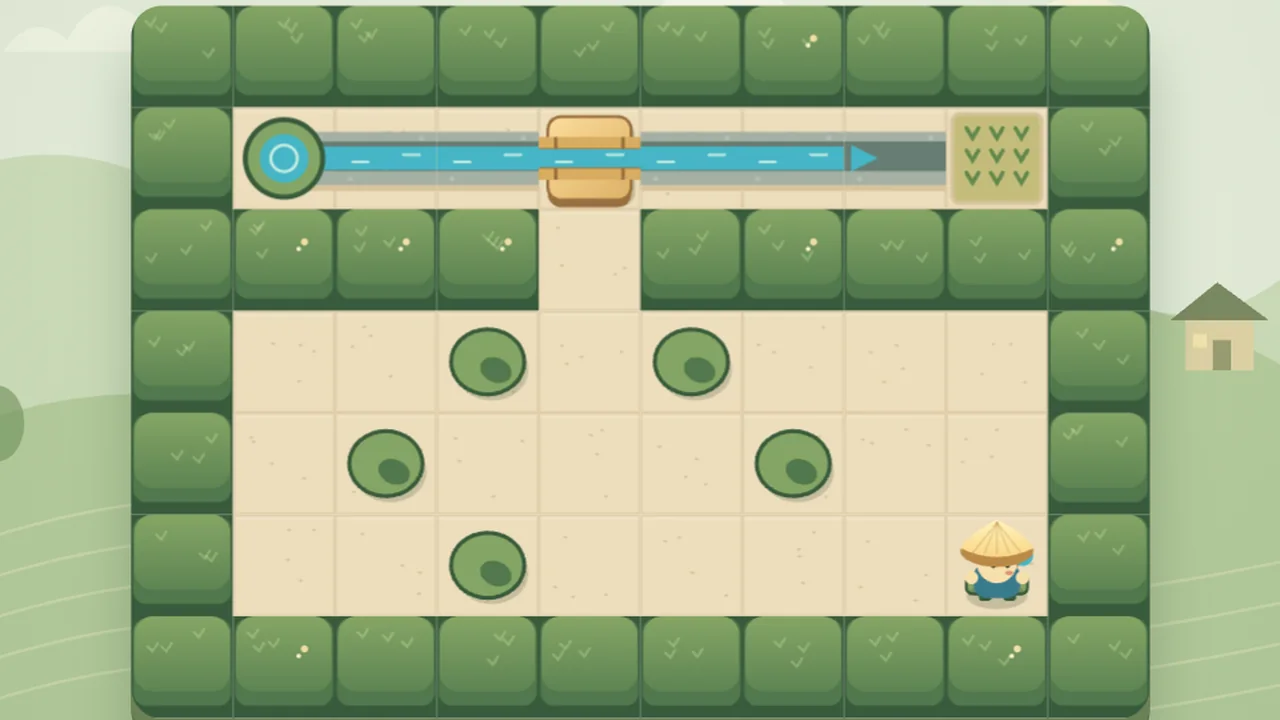
The action that lands you on the lever opens the gate and wets only the spring itself. From the next action on, each action moves the water one tile further along every open branch at the same time, and from then on waiting is the one action that costs no move. In First Sluice, the shortest solution is six moves (push the channel into the gap, walk to the lever) followed by six waits, because the paddy is six tiles downstream of the spring.
Counting the deadline for a gap
This gives you a simple count to make before you step on a lever. Number the tiles downstream from the spring: the first tile after it is 1, the next is 2, and so on. Water enters tile k on the k-th action after the gate opens. Your step or push is resolved before the water moves, so a channel pushed into tile k on that k-th action is still in time. Where the gap is empty, the leak happens on the action when the water should flow into it.
First Sluice shows both sides of this. If you walk straight to the lever first (four moves), the gap is tile 3. Walking back two tiles and pushing the channel up on the third action after the gate opened fills it just in time; the stage is won in 7 moves, one over par. Wait once before that push and the water leaks on the third action, with the message “The next tile has no connecting channel.”
Why the best routes open the gate late
The game’s solver, which sets every par, prices a move at 1 and a wait at 0. Time before the lever is unlimited, so the cheapest plan usually builds as much of the channel as possible first and opens the gate as late as the map allows. Opening early never saves moves; it only adds a deadline.
Some maps force an early lever, and those are the stages where counting matters. In Lever in the Gap, the lever sits on a tile of the watercourse itself, so a channel parked on it would leave nothing to stand on. The stored solution parks a bent channel beside the lever, steps on the lever on its 11th action, then pushes the channel onto the lever tile five actions later, on exactly the action the water reaches it. A channel standing on the lever carries water like any other; the lever only does something when a person stands on it.
What each failure message means
There are two ways to fail. “The water leaked” means some open arm of a wet tile faced something that does not open back toward it. The check covers every branch on every water turn, and a leak counts even if the last paddy fills in the same turn. “The water stopped” means no wet tile could advance while a paddy was still dry, without any leak. Paddies themselves take water from any side, so you only need an opening that points at one.
Under More on the fail card, the blocked spot is explained in one of these ways:
- “The channel points outside the board”: an open arm faces the edge of the map.
- “The next tile has no connecting channel”: the arm faces empty ground, a wall, a stone or a tile that carries no water.
- “The next channel’s inlet faces another way”: there is a channel there, but its opening on that side is closed. A wrong-shaped piece in the right place leaks.
- “Water cannot advance and a paddy is still dry”: the water stopped with no exit left.
Par, stars and what counts as a move
A move is a step or a push. Waits are free, and in Together a heavy push counts as two. Three stars need par or fewer moves; two stars need at most par × 1.3, rounded up; anything above that is one star. Since the margin is a percentage, short stages are tight and long ones forgiving:
- First Sluice, par 6: two stars up to 8 moves.
- Two Branches, par 16: up to 21.
- The Bend, par 31: up to 41.
- Harvest Sluice, par 39: up to 51.
- The Channel Across, par 47: up to 62.
Using Stuck? without losing stars
The first press of Stuck? (H) is free. If a way remains, it answers “There is still a way” and counts what is left. Ask right after walking straight to the lever in First Sluice and it says “At least 3 more moves · 7 in all — three stars (6) needs a restart”; on a better line it says “three stars still possible”. Only pressing Show the next move limits the stage to two stars. So the useful habit is to ask early: the moment a push feels doubtful, the count tells you whether that push already cost you three stars.
If the state is a dead end, it says “From here the paddies cannot all be filled” and offers a Go back button that rewinds to the nearest point from which the stage can still be won. On large boards the search stops at 200,000 states; then it reports “Too many paths to check from here” and sends you back to the last point where you were still on the stored shortest solution, which is always winnable.
Sluice boards: hold the plate for one action
A sluice board lets water in only while a person stands on its pressure plate. Water that reaches a closed board waits in front of it; this is not a leak. That makes the board a brake you can use. In At the Sluice Board (stage 20, Sunset Fields), the stored solution opens the lever on its 9th action, lets the water sit at the closed board for ten actions while the channel is fitted, and steps onto the plate on the 21st move.
The plate only matters on the action the water enters the board. Replaying that solution with a step off the plate straight afterwards still wins, because a board tile that is already wet stays open. In Together this frees the player on the plate as soon as the water is through.
Together: rounds instead of turns
In Together mode both players move freely until the gate opens. After that each player acts once per round, a wait counts as that player’s action, and the water advances only when both have acted. One tile of water therefore costs two actions, but the moves of both players add up against one par. In Two Together, 1P opens the gate on the 9th action of the stored solution and the water takes seven rounds to reach the paddy, during which 2P still makes four of the stage’s 13 moves.
Heavy blocks need the partner standing directly behind the pusher, and each push counts two moves even before the gate opens: in Heavy Stone the three heavy pushes made before the lever add six moves. After the gate opens, a heavy push takes both players’ action for that round, so it is only possible before either has acted, and the water moves straight after it.
Controls worth knowing on the first day
- F (Flow on a phone) waits for you every 200 ms until the stage is won or lost, or every 60 ms with reduced motion. Press again to stop. It costs nothing, since waits are free. In Together it is off while Careful moves is on.
- R restarts, and pressing Z straight after brings the whole attempt back.
- Z undoes one action at a time with no limit, waits included.
- With a game controller, the left stick or D-pad moves 1P and the right stick moves 2P in Together. A waits, X flows to the end, B undoes, Y opens Stuck?, Back restarts and Start opens stage select. Holding a direction repeats after 300 ms, then every 180 ms.
A sensible first session
All 28 solo stages and 9 Together stages are open from the start, and ◆ marks the next one you have not solved. Chapter 1, First Stream, has eight stages and the other four landscapes have five each. Play First Stream in order: each stage adds one idea, and The Bend (par 31) is placed at the end of the chapter because it runs much longer than stages 3 to 6. A level check fails if a stage’s par is more than 25% above the longest of the next three stages in its chapter.
Before your first move on any stage, do three things: match each gap to a channel whose openings face both neighbours, note which pushes would pin a channel against a wall, and count the tiles from the spring to every gap that you can only fill after the lever. If that count is shorter than your walk from the lever to the gap, change the order before you start.
Play it yourself
Mulkko
A turn-based water puzzle: push channels to bring water to the paddies. Solo or two-player co-op.