What the starting deck can do in one turn
Your first deck is ten cards, and all four kinds cost 1 energy: Ember cut (7 damage), Paper ward (6 block), Kindle (4 damage and 3 burn) and One more page (draw 2). Each turn gives 3 energy and 5 cards, so with the starting deck you play three cards and the other two go to the discard pile unused when you end the turn. The most a turn can do is three Ember cuts for 21 damage; a common split is two cuts and a ward, 14 damage and 6 block.
Ten cards and five per turn means the deck runs through in two turns. When the draw pile is empty, the discard pile is shuffled back in, including everything you played. Playing One more page pulls two of next turn's cards forward, so the pile empties earlier. Your hand holds at most 10 cards; draws past that are skipped and the cards stay in the draw pile.
This is why 0-cost cards matter more than they look. Needle flame (4 damage) and Folded time (4 block) are played on top of the three 1-cost cards instead of being discarded, and unlike Flowing ink, Dry tinder or Singed note they do not burn away, so they come back every shuffle.
How the number above the enemy is calculated
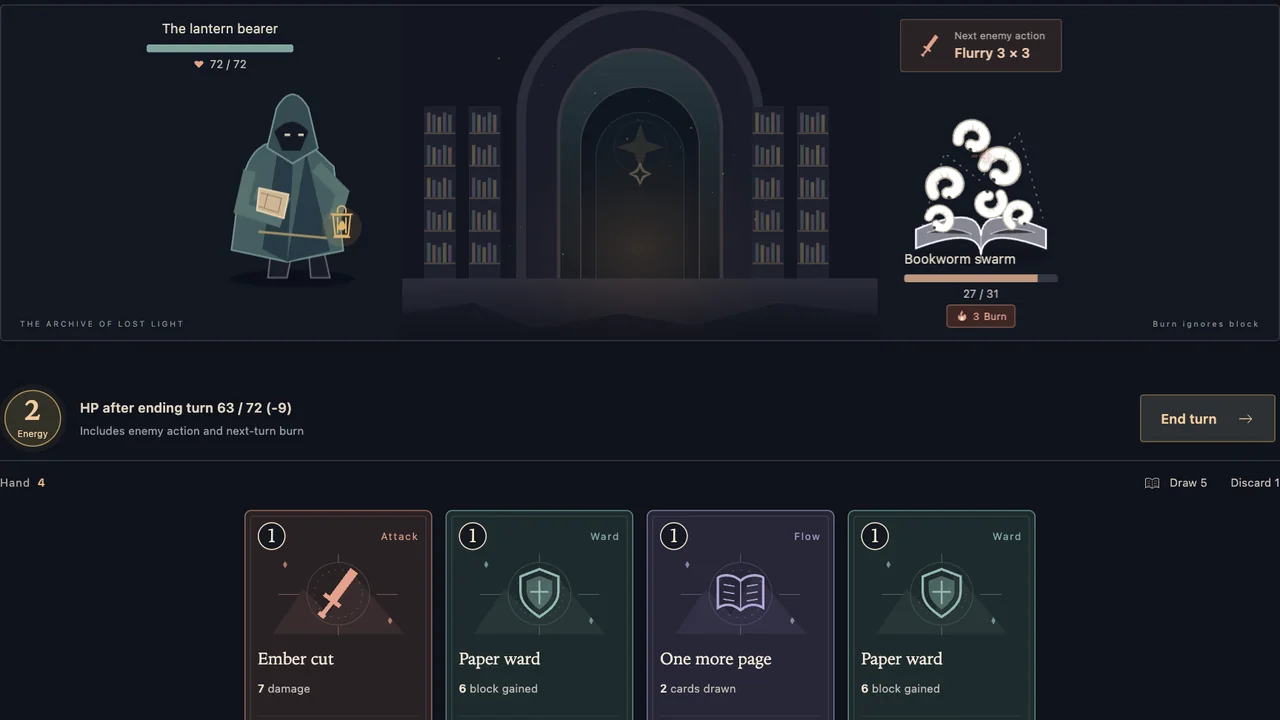
The sign over an enemy is its move for the end of this turn, and the value is fixed when your turn begins. The formulas are short:
- Attack: the enemy's attack plus any strength it has gathered.
- Flurry: 45% of that, rounded down, minimum 2, for 3 hits (2 hits for the Burning indexer and the Page devourer).
- Prepare block: 9 plus the room's position minus one, so 9 in room 1 and 17 in room 9.
- Scorch: 3 burn on you, plus 1 for every three rooms passed, plus 1 more from the Burning indexer.
- Gather strength: always +3.
Enemies that get stronger the longer you wait
Gathered strength never wears off for the rest of the fight. The Lost scribe in room 1 attacks for 7, gathers 3, then attacks for 10 twice, and its next loop hits 13. The Ash wraith follows the same attack, gather, attack loop from a higher base. The Ink moth (attack, attack, Prepare block) and the Bookworm swarm never gather strength, so a slow fight against them costs little; against a scribe or wraith, put damage first.
Regular enemies gain 7 HP for each room after the first and 1.1 attack, rounded down. Rooms 1 to 3 only draw the moth, scribe or swarm; the Shelf sentinel, Melting candelabra and Ash wraith join from room 4. At heat 0 a moth has 30 HP and hits for 6 in room 1, 51 HP and 9 in room 4, and 72 HP and 12 in room 7. An elite in room 3 has 95 to 109 HP depending on which of the three it is.
Choosing doors on the map
Room 1 is always a fight, room 8 is always a Lantern refuge and room 9 is the boss. Rooms 2 to 7 each offer two or three doors (three in about 46% of rooms over 2,000 seeds), and every one of them includes at least one fight. Room 2 never offers an elite or a refuge, so the earliest elite is room 3.
Fights are where gold and cards come from: 22 gold and a choice of three cards per normal fight, 35 gold plus a guaranteed rare and a choice of two relics per elite, and the Everlit lantern returns 3 HP after each win. A route that skips fights for shops and events reaches room 9 with fewer cards and less gold. The fixed test bot used to tune the game only takes an elite door when it has more than 43 HP and heads for a refuge, event or shop below half HP; a tuning rule, but a reasonable starting point.
Strength and thorns last the whole fight
Your strength and thorns reset only when a new fight starts. Strength adds to every hit of a damage card, so Resolve (+2 strength) makes each Ember cut deal 9 and adds 4 to Twin edge, which hits twice. It does not raise burn.
Thorns hit back once per enemy hit, whether or not your block stopped that hit. Thorn script gives 5 block and 2 thorns; the card burns away after one use, but the 2 thorns stay until the fight ends. Against a three-hit Flurry that is 6 damage each time it comes round. Thorn damage is taken off the enemy's block first, like any other damage.
Picking cards and upgrades
A card reward shows three cards and never includes the four starting cards. Each slot has a 15% chance to be rare, and after an elite the first slot is always rare. You can continue without a card; after an elite you still have to pick one of the two relics.
An upgrade adds 3 damage, 3 block, 2 burn, 2 healing, 1 strength, 1 thorns or 1 energy to whatever the card already does. A card that only draws gets one more draw; a card that draws as well as dealing damage or blocking does not. So an upgraded Ember cut deals 10, Paper ward gives 9, Kindle deals 7 with 5 burn, and One more page draws 3.
Gold: what comes in and what it buys
You start with 40 gold (25 from heat 3). The Wandering shop sells three cards, 45 gold for a common and 65 for a rare, one relic for 90 when you do not own it yet, and card removal for 35. You can buy and remove more than once in a visit while gold lasts, but the deck cannot go below five cards. Ember cut and Paper ward never appear for sale; Kindle and One more page can.
Two normal fights take you from 40 to 84 gold, enough for a removal and a common card in one visit. Since rules version 5, spent gold counts toward score as if you had kept it, so there is no score reason to hold gold back.
The eight events, in numbers
An event room picks one of eight encounters, and none repeats within a run. Each has two choices; the first is locked when you cannot pay its cost.
- Someone left a letter: 5 HP and 25 gold, or lose 9 HP for a relic you lack (60 gold if you own them all).
- The ember altar: −6 max HP to upgrade 2 random cards, or recover 8 HP.
- A forgotten shelf: a random rare card, or 40 gold.
- The ashen mirror: lose 8 HP to copy a non-basic card you choose, keeping its upgrade, or recover 12 HP.
- The ash brazier: lose 5 HP to remove an Ember cut or Paper ward you choose, or 30 gold. This is a shop removal paid in HP.
- A wandering scholar: 50 gold for a relic you lack (the shop asks 90), or a free upgrade on a random card.
- The ink spring: 30 gold for +8 max HP and 8 HP, or recover 25% of max HP.
- The librarian's ghost: stake 30 gold on an even chance of getting 80 back, or take a random common card.
Room 8, then the boss
The refuge before the boss offers 30% of max HP, rounded up (22 HP at 72 max; 25% from heat 4), or a permanent upgrade. The heal button shows the exact HP you would get back, capped at what you are missing. Both bosses open with a 20-damage hit at heat 0: the Hollow archivist attacks, and the Page devourer uses a Draining strike that heals it by whatever you fail to block. Two Paper wards stop only 12 of that, so if your HP is low, the heal usually decides more than one extra upgrade.
The map names your boss from the first room, so you can collect block for the devourer or plan for the archivist's change at half health while choosing rewards.
Common first-run mistakes
- Taking a fight past turn 50. The run ends as a loss, and the result screen says so.
- Ending a turn with unplayed energy when a 1-cost card was in hand. Unplayed cards are discarded, not kept.
- Forgetting burn on you. Scorch ticks at the start of your turn, before you draw, and ignores block.
- Playing Offering at low HP. It costs 4 HP and cannot be played at 4 HP or less.
- Saving Resolve or Thorn script for later in a fight. Their strength and thorns last until the fight ends, so each turn you wait is a turn of bonus lost.
Free run, daily vault or a friend's seed
Begin a journey gives a random seed at any ember heat you have unlocked; winning at your highest heat opens the next one. After losing a free run, Same seed again restarts the same seed so you can try different doors. The daily vault uses one seed per UTC date at heat 0, so everyone sees the same map and boss, and saving to the daily board needs a GameNow sign-in. To play against a friend, share a free run's result: the link carries its seed and heat, and Accept challenge starts the same rooms against the same boss. Your progress is saved in the browser after every choice, so Continue journey resumes a run you left.
Play it yourself
Ember Vault
A solo deckbuilding roguelite. Build a path card by card in 10 minutes.