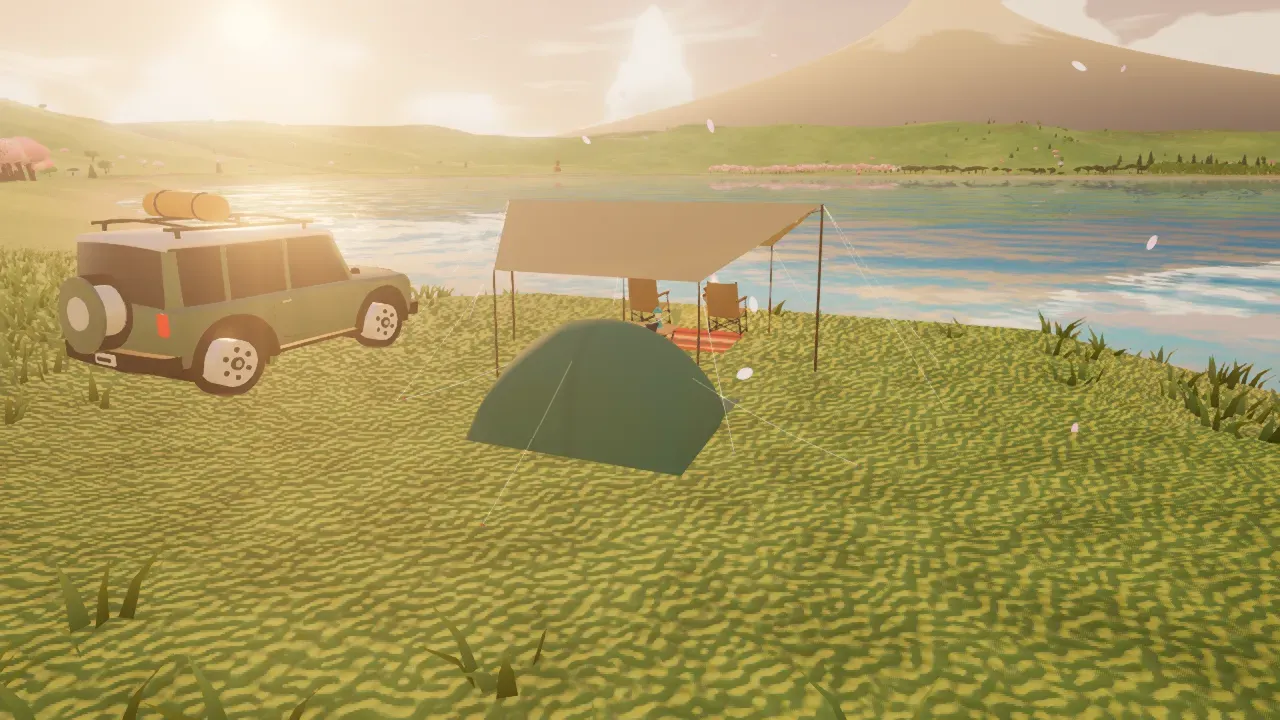
A campsite beside a WORLD DRIVE road
WORLD CAMP has no map of its own. Its 15 campsites sit beside 15 of the 21 WORLD DRIVE courses and use a copy of that game's terrain, sky, water, props and cars taken straight from that game; places are fixed in WORLD DRIVE and copied over, so the two games share one world. The copy is never edited by hand. Instead, as the ground is built, each pitch is levelled over a 7.5 m radius and blended back into the ground by 13 m, then tinted to packed earth, stripped of tall grass, and cleared of trees and houses along with the straight track that leads in from the roadside entrance.
The pitches were picked by a script that rebuilds each course's terrain exactly as WORLD DRIVE does. A spot needs a 12 m square that rises no more than 2.4 m with a slope under about 11°, a distance of 26 to 115 m from the road, and a straight drive from the entrance that does not cross water. Each campsite gets three pitches at least 40 m apart; the script favours a mix of waterside, view and cosy spots but takes the best ground first, so all three at Fuji are by the lake. Each pitch also stores a view direction: open ahead, toward a distant peak or water, with the road behind.
You drive the last stretch yourself. The car's body tilts with the ground under all four wheels, the wheels spin on climbs steeper than about 26°, water slows it, and the trees left around the site are solid. Stop inside pitch A, B or C and press 'Camp at pitch'; the car then parks itself at the edge nearest the entrance, facing the view, leaving the front of the pitch free. 'Auto drive' does the steering if you prefer.
Three tents, three ways up
The mini dome sleeps one or two on a 2.1 × 1.45 m floor: two long poles cross in an X, a short brow pole goes over the door, and a fly covers it. The large tunnel shelter sleeps four to six on 3.0 × 5.6 m, with three arches in colour-coded sleeves — blue in the middle, red at the front, yellow at the rear. The air tent sleeps four on 3.2 × 4.0 m and has no poles; two valves inflate its beams to about 7 psi. Pegs and guy lines come to six and four on the dome, eight and six on the shelter, and six and six on the air tent.
Each tent goes up in five phases: ground sheet, door, poles or beams, pegs and tension. Every phase is a task list with an order rule, and a task done out of turn is not carried out; it counts as a mistake, and the game names what comes first and highlights it. One star means the tent is up, two allow up to two mistakes with an average quality of 0.55, and three need no mistakes and 0.8.
Ground sheet first, then the door
The first phase clears three stones or pine cones (four for the shelter), in any order, before the sheet can go down. Where the sheet lies is where the tent will stand, and the game refuses a spot off the levelled pitch or overlapping the car or other gear. In real camping the sheet guards the floor against stones and damp; here it also fixes the footprint first.
Next you unroll the tent and turn its door in 15° steps, while the screen shows the view as up to three dots and says whether the wind is at your back. Door quality is 60% view and 40% wind, and the wind part drops sharply once the door points within 60° of where the wind comes from. Each pitch's wind blows from 99° to 153° off its view direction, so a door aimed straight at the view never faces it. That is the usual advice: a door into the wind lets gusts fill the tent, while the closed back end takes them better.
Poles in the right order
On the dome, the X poles go in first and the tent is raised by seating their ends at the corners; only then come the brow pole and the fly. The X gives the dome its shape, while the brow pole only holds the cloth out over the door, so before the dome stands it has nothing to push against. The shelter starts with the tallest, middle arch, then the front and rear, before you hold the button for about two seconds to pull it up, following the common tunnel-tent habit of starting with the longest pole.
The air tent swaps poles for a pump and a gauge, middle beam first. Each stroke adds about 0.85 to 1.1 psi, the valve can be closed from 5 psi, and the green band is 6 to 8 psi. Going past 9.5 psi opens the safety valve with a hiss and counts a mistake, and closing at 5 psi gives that beam a quality of only 0.5.
Pegs, the hammer and the green band
The dome and the air tent use the diagonal rule: after any first corner, the next must be the opposite one, then any remaining corner and its opposite, with loops last. Pegging opposite corners in pairs keeps the floor square, because each new peg pulls against one already set across the tent. The shelter goes rear corners first, then the front two once the body is pulled taut, then the side loops.
Each peg takes two hammer hits. A marker swings across a meter, fastest through the middle, and a hit scores by how close to the centre it lands — above 0.85 is 'Perfect!' — while the marker speeds up 8% after each hit. The pegs are drawn leaning outward, heads away from the tent, as in the usual advice of about 45°: angled against the line's pull, a peg is pressed into the soil rather than levered out. The game scores the timing, not the angle.
Guy lines use a slider that starts slack at 30%. The green band runs from 0.62 to 0.82 with the best value at 0.72; inside it you score at least 0.75, and outside the score falls fast, to about 0.53 at 0.90. The + button moves 5%, so eight presses from the start land on 0.70. Loose cloth sags and ripples more in the wind, and an over-tight tarp line turns reddish.
A tarp that stands on a pole and two lines
Next comes a hexa tarp, with main poles 4.8 m apart at 2.3 m and four side corners, or a recta, with poles 4.4 m apart at 2.4 m and six side points. It starts in front of the tent door and can be moved and turned. The game refuses a spot where a main pole would stand on the tent or the tarp's centre comes within 1.6 m of the tent's.
The main phase uses the pairs rule: raise pole 1, peg its two guy lines, then raise pole 2 and peg its two. Each pole's lines run out in a V to pegs about 1.6 m beyond it, so with the cloth pulling from the other side the pole is held from three directions and stands alone. Raising pole 2 before pole 1's lines are in is a mistake, because a real first pole would topple while your hands were busy.
Then you choose the sides. Side poles lift each corner to 1.5 m (1.6 m on the recta) for an open space, while side lines peg the corners down to about 1 m, which copes better with wind. Each corner is hammered, and the phase ends by tensioning the main and side lines into the same green band.
Striking camp in reverse
Teardown is the setup reversed. A lit fire is doused first, your gear is loaded into the car, and the line décor comes down by itself. The tarp loses its tension and sides, then pole 2's guy pegs and pole 2, then pole 1's, and is folded; the tent then loses its guy lines, pegs and poles or air, is rolled, and the sheet is folded last.
Each step has a reason. A tensioned line keeps its peg loaded, so releasing it first lets the peg come out cleanly. Poles leave opposite to how they went in: the dome sheds its fly and brow pole and is lowered before the X poles come out, the shelter is lowered and loses its rear, front and middle arches, and the air tent empties its front and rear beams before the middle.
Teardown is worth 15 of the 100 camp points. Its tasks have no timing or slider, so only the order counts, and each mistake costs about 1.2 points. Gear flies into the trunk as you go, and the trip ends when you drive back to the road, yourself or with 'Auto drive out'.
Décor, the fire and the speaker
A table, a chair and a fire pit are required; up to four chairs, two lanterns, firewood, a cooler, a rug, a Bluetooth speaker, bunting and string lights are optional. Items start where campers usually put them — the table under the tarp, chairs at its front edge facing the view, the fire pit in front — and can be dragged, turned or removed. Bunting and string lights hang between two points you pick: the tent's top, front or back, a tarp pole, a side pole, or the car's roof.
To relax, you sit in a chair and look around in first person, light the fire with a match and add wood, play music, move the time of day and take photos stamped with the campsite name and date. Time only runs forward, so going from night to midday passes through the morning; stars appear as it darkens, and Lofoten has an aurora. The speaker plays eight Kevin MacLeod tracks from where it stands, so the sound shifts as the camera moves.
The camp score is tent 35, tarp 25, décor 15, relaxing 10 and teardown 15. Décor gives 2 points per kind of item plus up to 4 for extra copies, capped at 15; relaxing gives 3 for the fire, 3 for music, 2 for staying until dark and 2 for sitting down. There is no ranking; the score only appears on the result screen, in the journal and on invite cards.
Invite links: visit, or camp next door
An invite link packs your campsite into a short code: place, pitch, time of day, car, where the tent and tarp stand and face, every item, the line décor and the score. Positions are kept to 0.1 m and angles to about 1.4°, with no nickname or account. The game removes the code from the address bar as soon as the page opens, and messenger previews name the campsite, tent and tarp beside a picture of the place.
Your friend skips the menus and sees a card with your campsite and score. 'Visit the camp' opens it at the saved time of day to look around or sit in your chair, which lights your fire. 'Camp next to them' loads your finished camp on its pitch, marked as taken, and your friend drives in to another pitch and starts from the ground sheet; there is no live multiplayer. Finished trips go into a camp journal in the browser, and signing in with a GameNow account keeps up to 200 of them across devices.
Play it yourself
WORLD CAMP
Drive off-road and pitch camp in 3D. Pick a spot at one of 15 places from a Mt Fuji lakeshore to alpine meadows and aurora fjords, pitch your tent and tarp step by step from ground sheet to poles, pegs and tension, relax by the fire with music, then strike camp in reverse. Send friends your camp link and they can pitch next to you.