Every miss is wide
A shot is aimed at a point on the goal line, then pushed sideways by a random error of up to ± a value the game calls spread. The goal is 10 m wide, so the posts are 5 m from the centre. Height never matters: the hardest kick peaks at about 1.6 m, well under the 3.55 m bar, and the keeper can reach anything below 2.8 m. A shot either goes in, is saved, or goes past a post.
Spread starts at 0.35 m and adds, in metres:
- Distance: 1 m for every 14 m between you and the goal line.
- Pace: up to 0.75 m when running faster than 7.2 m/s. Sprinting with the ball (10.1 m/s) adds about 0.63 m.
- Angle: 0.07 m for every metre you stand wider than a post.
- Corner aim: 0.25 m for every metre the aim point is past 3 m from the centre.
- Pressure: 0.9 m when an opponent is within 1.8 m.
- Then a one-touch finish multiplies the total by 0.55, and each pass in the current chain cuts it by 10%, up to four.
What that means in practice
If you hold no up or down when you release, the shot aims 2.6 m from the centre on the side away from the keeper, leaving 2.4 m to the post. Worked through the formula, a central shot at walking pace with nobody close never goes wide inside 25 m and has about a 2% chance from 30 m. Sprinting at 25 m makes it about 7%; a defender within 1.8 m at 20 m about 5%; both together about 14%. These are wide-miss chances only. Whether the keeper saves it is a separate question.
The trap is the keyboard. Any up or down key held as you release aims 4.3 m out, 0.7 m from the post, with the corner penalty added. Then about a quarter of shots go wide even from 10 m, and about a third from 20 m. A one-touch finish after a four-pass chain shrinks the error enough that the same corner shot from 15 m stays on target. On a stick, a partial push of about 0.7 aims at 3 m with no corner penalty.
Power and the keeper
Holding Shoot for up to one second raises the kick from 26 to 44 m/s, plus 4 for a one-touch and 1 for each chained pass. The ball then loses roughly a third of its speed every second it rolls. A keeper's reach is 2.15 m against a ball at 20 m/s or slower and shrinks as the ball gets faster, so what counts is the speed at arrival. Calculated for a Pro keeper:
Keepers also wait before reacting to a shot: 0.2 s on Rookie, 0.15 on Semi-pro, 0.13 on Pro and 0.09 on Legend, then dive at 9.5 m/s. The closer and harder the shot, the less of that dive they get.
- Uncharged from 20 m: arrives at about 17 m/s, and the keeper keeps the full 2.15 m.
- Full charge from 20 m: about 35 m/s on arrival, reach about 1.78 m.
- Full charge from 10 m: about 40 m/s, reach about 1.66 m.
Speed and stamina
The player you control runs at 7.5 m/s and sprints at 11. With the ball it is 8% slower, and after 4.5 seconds of solo carrying the penalty grows over 3 seconds to 24%. AI outfielders run at a share of that pace: 0.8 on Rookie, 0.86 on Semi-pro, 0.88 on Pro and 0.95 on Legend. Sprinting with the ball, you outrun Rookie, Semi-pro and Pro defenders (8.8, 9.5 and 9.7 m/s at a sprint) but not Legend ones (10.5 m/s).
Sprinting drains the full stamina bar in about 4 seconds, about 40 m. Not sprinting refills it at 0.16 a second, so from empty it takes over 6 seconds. Holding the ball past 4.5 seconds slows the refill, and from about 6.7 seconds it drains even while you walk. Save the sprint for the run in behind, not for carrying the ball into a crowd.
How the game chooses your receiver
Pressing Pass scores every outfield teammate and picks the highest. The browser runs the same rule to preview the receiver before you press. The weights explain most surprising passes:
- Direction held counts most. A teammate more than about 70° off it takes a heavy penalty, so hold a direction toward the player you want.
- With no direction held, teammates further forward are preferred.
- About 11 m away is ideal; every metre nearer or farther costs a little.
- Space counts: each metre between the teammate and the nearest opponent adds, up to 6 m.
- Each opponent within 1.4 m of the passing line is a big penalty. Any opponent within 1.15 m of the rolling ball can take it.
- A person scores higher than an AI teammate, and a player calling for the ball gets a large bonus for 1.5 seconds.
- Pass speed is 10 m/s plus 0.8 per metre, between 14 and 24, aimed where the receiver is running.
What keeps a chain alive
The chain counts completed passes in a row by your team. A pass that bounces off the boards still counts if a teammate collects it. Picking up your own team's loose ball, such as a shot rebound, neither adds to it nor resets it. An opponent touching the ball, a tackle or a kickoff resets it to zero. The chain feeds the shot bonus, assists, and the Team goal challenge, which needs a goal scored while the chain is at three or more.
The Court Tour
Since 11 October, playing alone means choosing a court instead of a level. Seven courts are set at night spots around Seoul, each with a fixed AI level and a challenge. Winning a court unlocks the next one. Each court has three stars: Win, Challenge and Clean sheet, and the clean sheet counts only in a win, so a 0–0 earns nothing. Stars are only ever added. Progress is kept on this device, and earlier practice wins carry over as wins on courts of that level or below.
- COURT 01 Seongsu Rooftop, Rookie: Score a goal.
- COURT 02 Mangwon Riverside, Rookie: Chain 3 passes.
- COURT 03 Euljiro Underpass, Semi-pro: Win 2 tackles.
- COURT 04 Gwangjang Market Alley, Semi-pro: Score a one-touch goal.
- COURT 05 Under the Sindorim Overpass, Pro: Team goal — score after 3 passes.
- COURT 06 Jamsugyo Riverbank, Pro: Win by 2+ goals.
- COURT 07 Seoul After Hours, Legend: Score 2 goals.
Clearing the challenges
On COURT 06, golden-goal extra time ends at the first goal, so a two-goal margin has to come in normal time. On COURT 03 only your own tackles count. AI defenders never tackle, so you need to be close to the carrier from the front or side. The one-touch on COURT 04 must be a shot released within 0.6 seconds of collecting a pass. Press Shoot as the ball arrives, because you cannot kick for 0.3 seconds after the touch. Your first solo match also runs a short controls drill: move, pass, shoot, switch. On a phone the button for each step is highlighted, and you can skip it. P or Esc pauses a solo match, and so does leaving the tab.
Alone versus with friends
Alone, you are the whole team. When an AI teammate collects the ball, control jumps to that player. After you pass, control follows the ball, so you play the next touch too. If the other side wins the ball more than 14 m from you, you are moved once to the defender nearest it.
With two or more people on a side, control never jumps to a friend's player. AI teammates pass to people rather than playing on: after 0.15 seconds to someone calling, otherwise after 0.55 seconds or as soon as an opponent is within 2.4 m. AI defenders on a side with people take 1.8 times as long to win the ball by pressing, so tackling is the people's job. In friend rooms both sides play at Pro.
Play it yourself
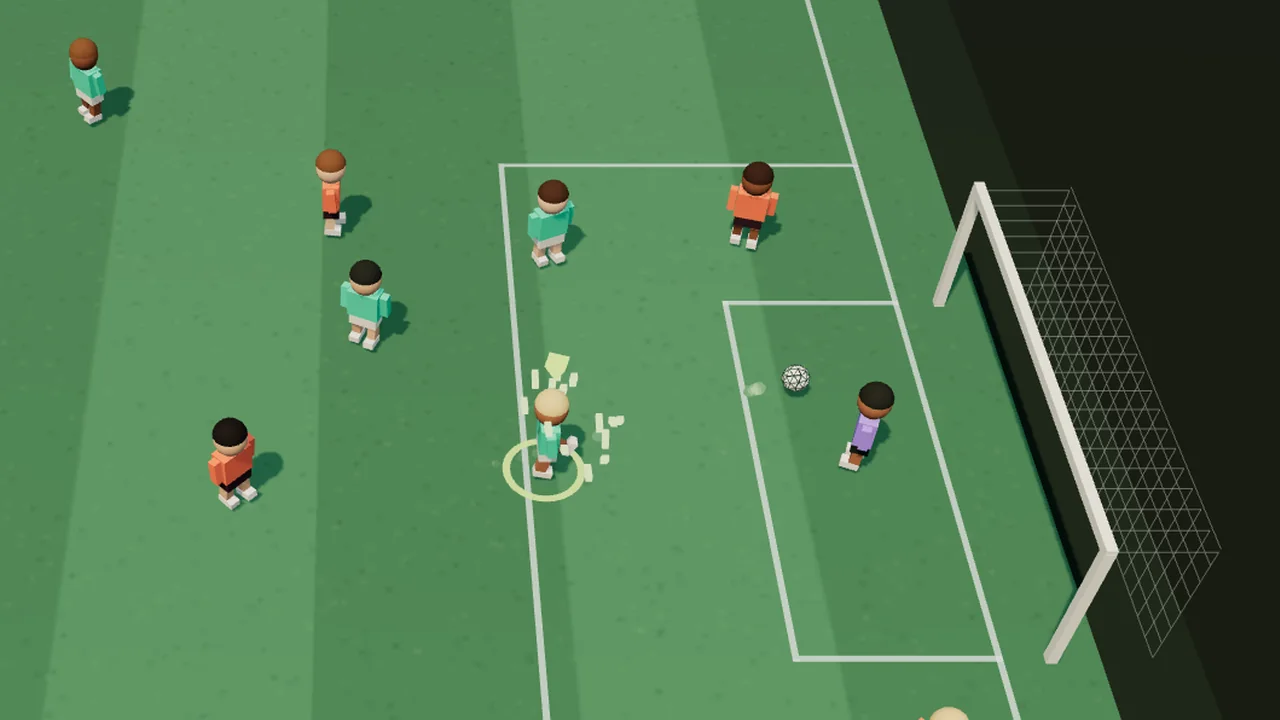
SEVEN STREET
7-a-side street football. Practice against AI right away, or team up with friends from 1v1 to 4v4 in a three-minute match. AI fills the empty spots.