Three fighters, three ways to fly
NOVA SQUADRON is a 3D space combat game: you fly a starfighter for the Nova Squadron against the drone fleet of a runaway machine legion. Before every sortie you pick one of three fighters, and the numbers behind them are quite different.
The Lancer is the balanced one: 110 hull, 80 shield, a cruise speed of 125 m/s and 235 m/s on boost, twin lasers at 9 damage and 8 shots a second, 6 missiles, 1 torpedo and 3 decoys. The Stinger is the interceptor: only 80 hull and 65 shield, but 145 m/s (275 on boost), the sharpest turning, 10 shots a second at 7 damage, 4 missiles, no torpedo, 4 decoys and an evasive roll that comes back after 1.7 s instead of 2.4. The Bulwark is the heavy: 160 hull, 115 shield, a slow 112 m/s and the widest turning circle, but 14 damage per laser shot, 8 missiles and 2 torpedoes.
The flight model is arcade, not real inertia. Your velocity swings quickly toward where the nose points with a little slide, and when you let go of the roll it levels the wings back to the bank your turn wants. That self-levelling is deliberate: on a phone it is easy to lose which way is up, and a fight should be about the target, not the horizon.
Lead the shot
A laser bolt takes time to arrive — 900 m/s for the Lancer and Stinger, 820 m/s for the Bulwark, out to 1.4 km — and fighters never stop moving. So the HUD draws a small yellow lead circle in front of your current target: the point where target and bolt will meet if neither changes course. Put the reticle on that circle, not on the ship.
Each input gets a little help. When the lead point of an enemy sits within a narrow cone around your nose, your bolts are bent toward it: about 2.2° with a mouse, 2.9° with keys, 4.3° with a gamepad and 5.7° on a touch screen. Touch also has auto-fire, on by default and switchable in the pause menu: it fires when an enemy's lead point is within about 4° of the nose.
The lasers have a heat gauge, and if it ever reaches the top they lock for 1.4 s before cooling back to 40%. Pickups change the gun for a while: the spread laser fires three beams at 80% damage for 25 s, the ion cannon fires slowly (about a third as often) but hits 4.2 times as hard and 2.2 times again against big targets for 25 s, and the rapid laser fires 1.8 times as fast with no heat at all for 20 s.
Lock-on, missiles and torpedoes
Missiles need a lock. Keep the target within about 15° of the nose (a third wider on touch) and inside 1,700 m, and the lock ring fills in 0.9 s; drift away and it drains. On a phone the ring is drawn around the MSL button itself. A missile flies at up to 360 m/s, turns hard, lives 6.5 s and does 60 damage.
If the locked target is big and you still carry a torpedo, the same button fires a torpedo instead. Big means freighters, frigates, bombers and every part of a capital ship or the moon: turrets, shield generators, reactor cores, hangars and the cooling vent. A torpedo locks in 1.2 s from as far as 2,200 m, flies slower at 240 m/s and does 420 damage — but only 30% of that to a fighter. A missile fired without a lock just flies straight ahead.
Torpedoes are scarce on purpose. The Lancer starts with one, the Bulwark with two and the Stinger with none; you carry at most four. The missions hand them out where they matter, as you will see below.
Evade, shields and decoys
EVADE throws the fighter into a 0.62-second roll to the side. From 0.04 s to 0.48 s after you press, enemy lasers and missiles pass straight through you. The roll then has to recharge: 2.4 s on the Lancer, 1.7 s on the Stinger, 2.9 s on the Bulwark. On a keyboard you can also double-tap A or D.
Shields soak damage before the hull. After 3.2 s without being hit they start to recharge at 16% of their maximum per second, so breaking away for a few seconds is often worth more than one more pass. A collision with a rock or a wall also hurts, and the faster you hit it the more it hurts.
When the missile alarm sounds, drop a DECOY. Whether a missile aimed at you takes the bait depends on distance: a missile more than 260 m away always does, between 120 and 260 m it does about two times in three, and closer than 120 m about one time in three. So drop it early. A decoy also breaks any enemy that is in the middle of locking onto you.
Supplies
Glowing supplies are collected simply by flying within 34 m of them. Enemies sometimes drop one: a drone about one time in twelve, a raider one in six, a bomber more than half the time and an ace always. Repairs give back 40% of the hull, a shield cell fills the shield, a missile pack adds 3 missiles, a decoy pack adds 2 and a torpedo adds 1.
The missions also place supplies on purpose: two torpedo capsules in front of the start of the dreadnought assault, more torpedoes the moment its shield generators fall, missiles between the asteroid patrol's waves, and a repair and torpedoes when the fleet showdown turns to the Mark II dreadnought.
Six missions
The campaign has six missions in order; finishing one opens the next. One star is for completing it. Two stars mean nobody was shot down — with friends, no more shoot-downs in total than the number of pilots minus one. Three stars need that mission's perfect goal, shown on the mission card. Every pilot has three fighters per mission and comes back after 5 s with 2.5 s of invulnerability.
- Asteroid Patrol — fly through four nav rings, then clear five drones, a raider wave and a bomber group. Three stars: finish within 5 min 30 s without being shot down.
- Convoy Escort — take three freighters to a jump gate 6 km away. Bombers go for the freighters, and a field of 14 mines sits across the route; the freighters stop in front of it until it is cleared. Three stars: all three jump.
- Nebula Ambush — guard a stalled frigate for 140 s while it reboots. Waves come every 26 s, and ion storms strike near you after a 2.2-second warning circle. Then the ace Specter arrives. Three stars: frigate hull at 60% or more.
- Dreadnought Assault — break two shield generators, then put torpedoes into the reactor core, which stays shielded until both generators are gone. Flak turrets, heavy cannons and a hangar launching drones defend it. Three stars: within 7 minutes without being shot down.
- Trench Run — dive into a trench 76 m wide and 84 m deep that runs 3.8 km across the Iron Moon, and hit the cooling vent in the end wall. Three stars: never shot down.
- Fleet Showdown — protect your flagship from bomber raids, then bring down a Mark II dreadnought while Specter returns. Three stars: flagship hull at 50% or more.
Taking down big ships
Against a dreadnought the order matters. Generators have 360 health, so one torpedo breaks one when you fly alone. The core has 1,100 and simply shrugs off fire while a generator stands — the HUD says so. Each part also pays: 1,000 points for a generator and 5,000 for the core. The hangar launches two drones every 24 s while it stands, so killing it early thins the sky.
In the trench, the moment you cross the rim every pilot receives two torpedoes. Stay low: more than 24 m above the rim for over 1.2 s and the surface flak starts hitting you. Energy barriers cross the trench with a gap that drifts up and down; fly through the gap or lose your whole shield and 34 hull. Raiders chase you from behind, Specter joins a little before halfway, and if you pass the vent without destroying it you are sent back to a third of the way along to try again.
Flying with friends
Co-op holds up to four pilots. Send the link or the four-character room code; the host can launch first, and friends join in the middle of a mission with 2 s of invulnerability. Alone you fly with two AI wingmen, a Lancer and a Bulwark that come back 12 s after being shot down; with two humans there is one wingman, with three or more there are none. Each extra pilot adds 45% more enemies, and the dreadnought assault's generators and core, like Specter in the nebula and the fleet showdown, get 60% more health per extra pilot.
Team dogfight is Nova team against Red team, from 1v1 to 4v4, in three arenas: the asteroid belt, a dreadnought wreck and an ion nebula with storms. Empty seats are filled by bots unless the host turns that off. The first team to reach four kills per seat plus two — 10 in a 2v2, 18 in a 4v4 — wins, or the higher score after 5 minutes. Supplies appear every 13 s. Downed fighters return after 4 s. A friend who arrives during a round joins the next one.
The server runs the same rules at 30 Hz. Each browser flies its own fighter and sends its position 20 times a second, and your lasers are judged on your own screen — in a fast dogfight the hit you see should be the hit you get. If a connection drops, that seat is held for 30 s; in a team dogfight with bots on, a pilot who leaves is taken over by a bot. Online play never pauses; solo play does.
Built for a phone in portrait
Portrait is the default layout. Press anywhere in the lower left and a stick appears under your thumb; push up to climb. The right thumb has five buttons: FIRE (hold), MSL with its lock ring, EVADE with its recharge shown, DECOY and BOOST (hold). A full boost tank lasts about 4 s and refills at a little over half that rate. Up/down can be inverted in the pause menu.
With a gamepad the left stick steers, the right stick rolls, RT fires, RB fires missiles, A evades, B drops a decoy, LT boosts, LB brakes, Y switches target and Start pauses. On a computer the mouse steers like a stick around the screen centre: click or Space fires, right-click or F launches, C evades, X drops a decoy, Shift boosts, Z brakes, Q and E roll, and T or Tab switches target.
Records — each mission's best score, stars and clears, plus team dogfight games, wins and kills — are saved in the browser. Log in with a GameNow account and they are merged into your account, keeping the higher value of each.
Play it yourself
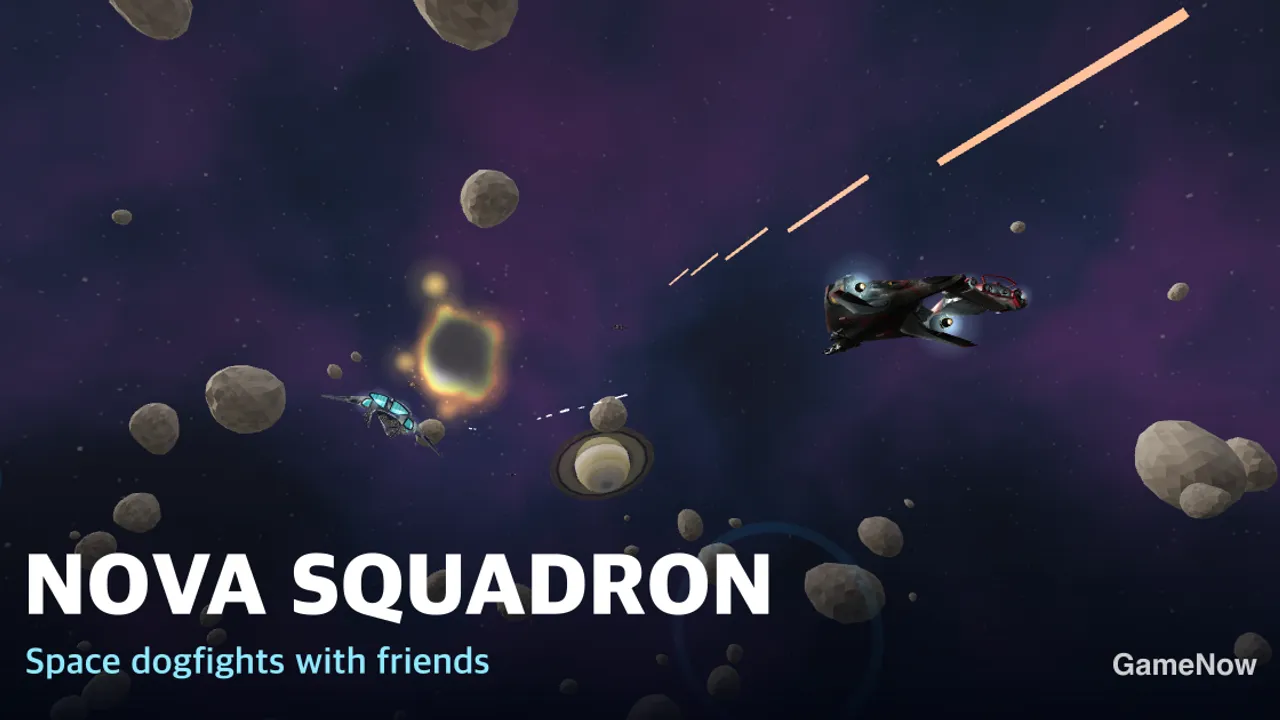
NOVA SQUADRON
Dogfight in a sleek 3D starfighter. Lead your shots, lock on for missiles and torpedoes, and roll or drop decoys to shake off fire across six missions, from an asteroid patrol to a fleet showdown. Friends join your wing with one link for co-op up to four, or split into teams for dogfights up to 4v4.