What you start with
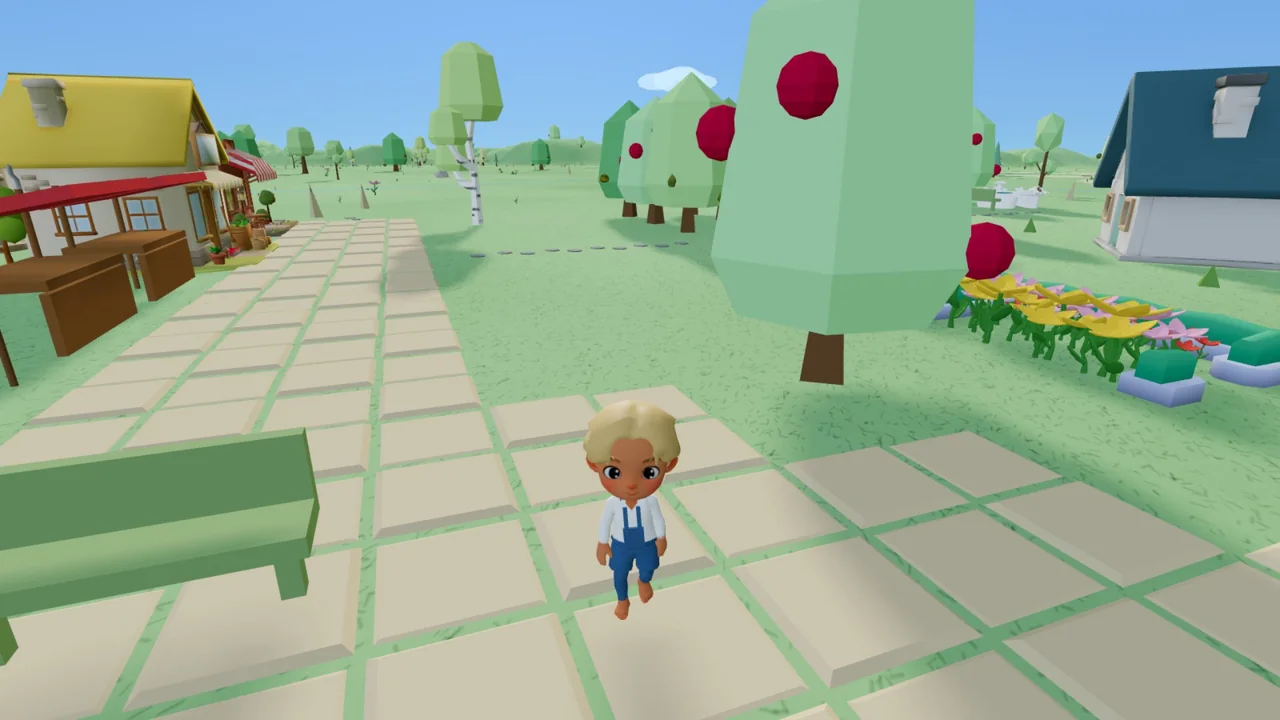
When you build your village, the server gives you Ⱥ3,000, a shovel and a watering can, and puts up a starter yard: a house with a bed inside, a campfire, a mailbox, a guestbook board, a bench and a telescope. Those seven pieces are logged separately from normal placement, so they do not count toward the later goal of placing things in your village.
Three shop items carry you through all four stages: a fishing rod (Ⱥ1,200) for the fishing goal, an axe (Ⱥ800) for the one tree you must chop in the last stage, and something cheap to place. Stepping stones at Ⱥ120 are the cheapest furniture in the shop. Rod, axe and two sets of stones come to Ⱥ2,240, so your starting money covers every purchase the stages require, with some left for food.
How the stage goals are counted
The Life Notebook (comma key) lists the current stage's goals with a bar for each. The server, not your screen, counts rows it already writes whenever you shake a tree, sell, cook, place, chop, give a gift or fill a request, and it counts fish and bugs from your Pedia.
Three consequences are worth knowing before you start:
- Counts are lifetime totals. Anything you do early carries forward: sales during First Day count toward the 15 sales in Going Further, and species you catch in stage 2 count toward the species goals later.
- Each sale is one count. The shop's Sell button sells one item per click, so ‘Sell at the shop 15’ means 15 clicks, not 15 different items.
- Finishing the goals does not move you on by itself. Press ‘All done! Open the next stage’ in the notebook; the server counts again before it raises your stage, and the goals can be done in any order.
Stages 1 and 2 in order
First Day asks for three tree shakes and one sale. A fruit tree holds three fruit, each shake drops one, and the tree refills five minutes after it was last picked. Conifers and broadleaf trees drop a branch instead, refill in 90 seconds, and still count as a shake. You must be within 3 m of the trunk.
Getting the Hang of It asks for one fish, one bug, one dish and two placed items. Bugs need no tool: walk up to one and press E when the catch prompt appears. For the dish, Fruit salad takes any two fruit and needs no fire. Every recipe with branches in it is cooked over a fire: you must stand within 4 m of a campfire and you also burn one Wood, which the shop sells for Ⱥ120 or a chopped tree gives three of. For the two placements, buy stepping stones and set them down in your own village.
Fishing by the numbers
Cast toward water up to 7 m away. A bite comes 2.5 to 9 seconds later and lasts 1.1 seconds; press again inside that window. Pressing before the bite loses the fish, and so does walking more than 1.5 m from where you cast from the shore. From a boat the window is 15% longer. After each catch the rod rests for 20 seconds before the next cast.
The server decides the fish when you cast, and the shadow that swims up shows its size class: up to 20 cm, up to 50 cm, up to 1 m, or longer. Rarity weighting is steep from the shore. Every fish has a rarity from 1 to 5, and a rarity-1 fish is about 4.6 times as likely as a rarity-2 fish and about 34 times as likely as a rarity-5 one. From a boat the weighting is flatter (about 2.5 and 8 times), which is why boats, which go on sale once you finish stage 2, are the way to the big catches.
Reaching 8 and then 15 species
‘Species in your Pedia’ counts fish species plus bug species. Fruit is recorded in the Pedia but does not count, and catching the same species again adds nothing. Stage 3 needs 8, stage 4 needs 15.
Fish are the easy half. The game has 17 fish, filtered by water type (sea, river or pond), climate, season, local hour and rain. In a temperate area in autumn, for example, a river allows crucian carp, minnow, goby, carp and trout, and the sea adds sardine, mackerel and sea bream, so fishing both kinds of water gets you to eight fish species.
Bugs are the hard half. Of the 14 bugs, each patch of land hosts only one or two of the species its climate, season and hour allow. Land with many wildflowers adds butterflies and bees, and a placed pond adds dragonflies and fireflies, still only in their season and hours. Snails come out only in rain, crickets from 16:00, fireflies from 19:00. So the fastest route to 15 is to catch bugs in neighbouring villages and wild land as you pass through them, and to travel to another climate or the other hemisphere, where seasons run the other way.
How friendship moves
Each neighbour has a hidden friendship value from 0 to 100, shown as Just met, Acquaintance (15), Friend (45) and Best friend (80). It changes in four ways:
- Talking: +4, at most once every 15 minutes, measured from the last talk that raised it. There is no daily cap.
- Gifts: +14 for any fruit, +28 for their favourite, −8 for the one they dislike, once per neighbour every 20 hours. A gift given too soon is refused and you keep the item.
- Requests: +12 when you deliver what they asked for.
- Time: −5 per day since you last talked to them, gave a gift or filled a request.
When neighbours pack up
A neighbour only leaves over a cooled friendship if it once reached 30 and has since fallen below 8. The check runs when the village owner walks into the village. When it trips, the neighbour starts packing and you have three days to talk to them or give a gift. In practice, someone you brought to 30 and then ignored for about four and a half days is at risk, so check in on new friends every few days.
Requests: the bottleneck in stages 3 and 4
With the Neighbours needs one filled request, and Going Further needs three in total. Each neighbour has a 38% chance of asking for something on a given UTC day, and a village has four to six neighbours, so with four neighbours roughly one day in seven brings no request at all and the notebook says ‘Nobody needs anything today’. Neighbours in other players' villages ask too, and the server accepts a delivery while you are in their village or next to it.
Requests are fruit 55% of the time, fish 23%, bugs 15% and a dish 7%, one to three of an item (a dish is always one). The reward is 1.6 times the item's base sell price times the quantity, plus Ⱥ60: three apples pay Ⱥ540 against Ⱥ300 at the shop. The reward ignores the daily price board, so on the rare day the requested item sells at ×2, the shop pays more.
Chores, streaks and selling
Daily chores start after First Day. You get three a day, one from each tier: easy village tasks (shake 5, pick 4 flowers, sell 5), tool tasks (3 fish, 3 bugs, cook 2, place 1) and a third slot. Gifts join the pool from stage 3, and 8 fish, 8 bugs or chopping a tree from stage 4. Rewards run from Ⱥ120 to Ⱥ320.
Selling has diminishing returns. The first 12 of an item sell at full price, each one after that 2% less, down to 40%. Selling 40 apples in one day pays Ⱥ3,216 instead of Ⱥ4,000, so spread big hauls over several days or turn them into requests and gifts.
Food keeps you working
Fullness drops 8 points an hour, even while you are offline. From full you stay Well fed (70 or more, 10% faster) for under four hours, become Hungry at 30 (no running) after about nine, and are exhausted at 10 after about eleven. While exhausted you walk at 55% speed and cannot gather, fish or cook. Raw fruit restores 8 to 26 depending on the kind; an apple gives 15. Fruit salad restores 30, the same as eating two apples raw, so it is only worth making for the cooking goal. Cooking pays off with the bigger recipes: fruit pie (three fruit, by the fire) restores 55, fish stew (two fish, by the fire) 70, and fruit cake (five fruit and a Ⱥ320 jar of honey, no fire) 100.
Common first-week mistakes
- Waiting at an emptied fruit tree. It takes five minutes; shake other trees meanwhile.
- Expecting the stage to open on its own. Press the button in the notebook.
- Buying a campfire. You already have one; stand within 4 m of it and carry one Wood.
- Giving a random fruit before you know the favourite. From Acquaintance (15) up, ‘Likes …’ with their favourite fruit appears beside their friendship level, and it is worth twice a plain gift.
- Letting fullness hit 10 far from food. Carry two fruit.
Play it yourself
animalEarth
Build a cozy village, decorate and meet friendly animal neighbors.