Three practice boards, one match board
Practice levels in Mine Rush no longer share one board. Since the 2026-10-11 update each level has its own size, and the header shows it, for example “Normal 9×12 · 20 mines”:
- Easy: 8 × 10 with 12 mines (15% of cells), with larger cells on a phone.
- Normal: 9 × 12 with 20 mines (18.5%). Online matches and Today’s minefield always use this board with the standard rules.
- Hard: 10 × 12 with 26 mines (21.7%). One column wider, with more mines in it.
The starting area and what progress means
The starting area grows with the board. It aims for about 14% to 23% of the safe cells: 10 to 16 cells on Easy, 12 to 20 on Normal and 13 to 22 on Hard. The generator tries up to 200 layouts to land in that range, and the start sits at least one cell away from the edge with its 3 × 3 block kept free of mines.
Progress counts opened safe cells against all safe cells: 68 on Easy, 88 on Normal and 94 on Hard. At time-up only that number matters, with fewer mine hits breaking a tie. Flags count for nothing in the result.
The two rules everyone knows, and where they stop
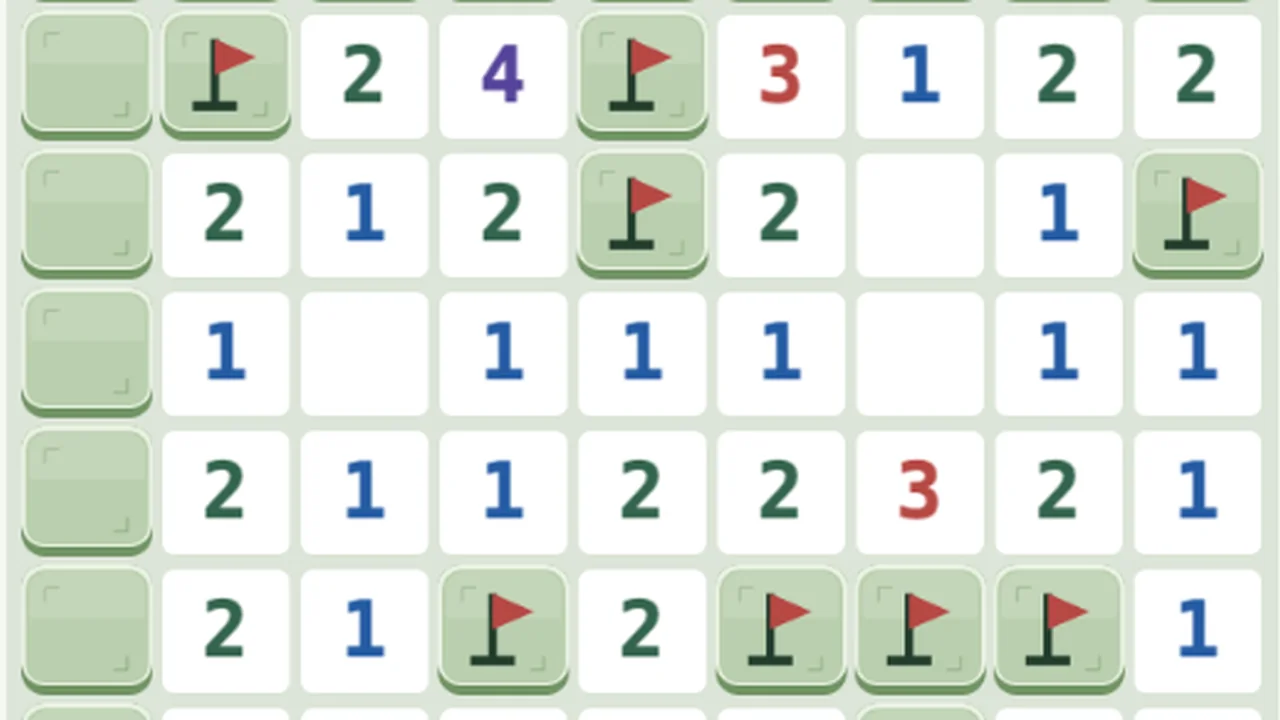
Every number counts mines among its eight neighbours, or five or three along an edge or in a corner. Two rules follow from a single number. If a number equals its unopened neighbours, they are all mines. If its flags and exploded mines already match it, every other neighbour is safe, and tapping the number opens them all at once (in practice, the chord check shows the cells first and a button confirms).
The practice AI uses exactly these two rules and nothing else. Whenever a solution needs two numbers compared, it has to guess. That is where you can pull ahead of it, so the patterns below are worth learning.
Patterns that compare two numbers
Each case below is a line of opened numbers with a row of unopened cells directly above and opened cells below. I checked each one by trying every possible mine layout with the game’s own neighbour rule, so the conclusions hold on Mine Rush boards:
- 1-2-1: the cells above both 1s are mines. The cell above the 2 is safe, and so are the cells just past each end.
- 1-2-2-1: the cells above the two 2s are mines, and the cells above the 1s and just past them are safe.
- 1-1 starting at the board’s side edge: the edge 1 can only see two unopened cells, so its mine is one of those two, and the third cell along, above the second 1, is safe.
- 1-2 starting at the side edge: the edge 1 accounts for one mine among the first two cells, so the 2’s second mine must be the third cell. Flag it.
What a guess really costs
A mine freezes you for 3 seconds, then 4.5, 6 and 7.5, and 8 for every hit after that; the count never resets during a round. An even 50/50 guess therefore costs 1.5 seconds on average if it is your first hit, but 3.75 seconds by the fourth. A cell that no number touches is not a coin flip at all. The AI treats such cells as having the board’s remaining average density, which at the start of a Normal round is about one mine in five.
So when you are stuck, use the counter first. “Mines left” is the total minus your flags minus exploded mines. It trusts your flags, so one wrong flag makes it wrong, and when you have placed more flags than there are mines, the counter stops at 0 and a red note such as “2 flags too many” appears. If the counter shows the last mines must sit in one region, every cell outside it is safe.
Round rules that rotate in practice
Practice changes one rule per round, in a fixed order counted on your device: Standard rules, Sector Survey, Smoke storm, Extra scan, 3-minute rush, then back to the start. Your first practice round on a device is always the standard one, and the result screen shows which rule comes next. The AI plays under the same rule as you.
- Standard rules: 2 scans, a Smoke shot every 18 opened cells, 4 minutes.
- Sector Survey: you start with 1 scan, and the board is cut into top, middle and bottom bands of rows. Opening 8 safe cells in a band gives one more scan, up to three more. A band the starting area already completed gives nothing.
- Smoke storm: a Smoke shot every 12 opened cells instead of 18.
- Extra scan: 3 scans instead of 2.
- 3-minute rush: the round lasts 3 minutes, and if nobody clears, more opened cells wins.
Playing each rule well
The practice AI fires Smoke the moment it has a shot and never uses Scan. In Smoke storm that means a shot after roughly every 12 cells it opens, and each one hides up to 14 of your opened numbers for 7 seconds. Solve the area you are looking at before the AI’s progress bar jumps.
In Sector Survey, spreading out pays: the second and third bands each give a scan, and a scan is worth the most when you are stuck or frozen, since it still works during a freeze. Extra scan is the round to try a scan on a real 50/50 instead of guessing. In the 3-minute rush, a round is less likely to end in a clear, so the time-up rule decides more games. A guess that opens a large area can be worth its freeze when you are behind.
The three result stars
Each finished round can earn three stars, and your best is kept separately for each practice level and for online matches and Today’s minefield:
- Beat the AI, or Beat your opponent online.
- Open over half with 0 mines hit: more than half of the safe cells without a single hit.
- Clear the board within the time limit: 1:00 on Easy and 1:30 on Normal and Hard. You must clear it and win.
Common mistakes
Most lost races come down to a few habits, each tied to a rule described above.
- Treating every stuck spot as a guess. A 1-2-1 or an edge 1-2 often solves it, and the AI cannot see those.
- Trusting “Mines left” after a doubtful flag. The counter is only as good as your flags.
- Spending a scan early on Standard rules. You get two per round, and they still work while you are frozen.
- Guessing late after several hits. By the fourth hit each freeze is 7.5 seconds or more, so a guess that was cheap at the start is now expensive.
- Ignoring the band counts in Sector Survey. Clearing one band completely earns no more than its first 8 cells.
From practice to matches
Practice works without the time pressure of a match: it can be paused, and the round is saved when you leave. When you sign in you can press Find opponent for a random match, use Play a friend to get an invite code your friend types under Enter code, or challenge someone from the Players list. All of these run on the Normal board with the standard rules, so a good first goal is to collect all three stars on Normal practice before playing people.
Play it yourself
Mine Rush
Read the numbers and find the mines. Practice solo or race on the same minefield.