The board and the tiles
GameNow's board is 8 columns by 10 rows: 80 tiles, 20 patterns, four tiles of each. The patterns are dots 1 to 9, bamboo 1 to 9, the red 中 and the green 發. The characters suit is left out, and each tile carries a small numeral in its corner so look-alikes such as 7 and 8 dots can be told apart on a phone.
Four tiles per pattern means every pattern is cleared as exactly two pairs, so the board holds 40 pairs in all. When you take one pair of a pattern, the other two tiles of it will eventually have to connect to each other.
The rule, exactly as the game checks it
Two tiles of the same pattern can be removed if a line joins them that runs only through empty cells and bends at most twice. One extra ring of cells around the board, the outer border, counts as empty at all times.
The game finds that line the way you can: from the first tile it extends straight lines in all four directions until something blocks them, then turns once from every empty cell it reached, then turns a second time. If the second tile is reached within those three straight segments, the pair goes, and the route with the fewest bends is the one drawn.
Pressing two tiles of different patterns is not a mistake; it just changes your selection. Only two matching tiles with no legal route count as a miss and cost energy.
Three shapes to look for
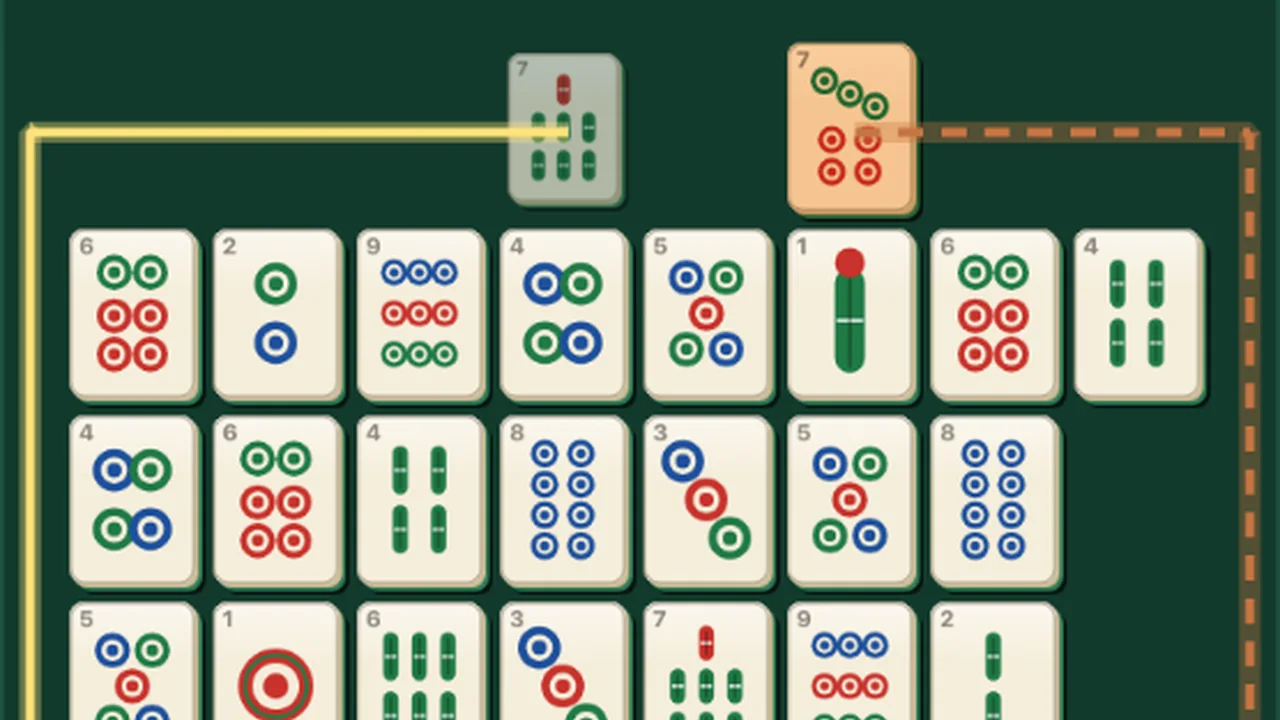
Every legal route is one of three shapes, and after a miss in solo play or the daily board the route view draws candidates of each kind under the names Straight, Inside detour and Outer border.
- Straight, no bend: the tiles share a row or column and every cell between them is empty. Two matching tiles that touch always qualify.
- One bend: the tiles sit at two corners of a rectangle, and one of the other two corners is empty, along with both straight legs leading to it.
- Two bends: each tile can step straight out to an empty cell, and those two cells are joined by an empty straight line. Inside the board that makes a Z or a U; through the outer border it makes a U around the edge.
Pairs that always connect, and ones that never do
To find out which edge pairs are guaranteed, I filled the board completely, put two matching tiles in chosen places and asked the game's route finder:
- Two matching tiles in the same outer row or column always connect, whatever lies between them: if no shorter route exists, through the border with two bends.
- A corner tile counts as part of both of its edges, so it connects to a match anywhere along either one.
- A tile in the top row and a match in the left column, neither in the corner, would need three bends to go around the corner, so the border alone never joins them.
- The border alone never joins a top-row tile to a bottom-row tile either, even in the same column, or one corner to the opposite corner. Such pairs need empty cells inside the board.
What the opening offers
On a fresh deal no cell is empty, so the only removable pairs are touching twins and twins on the same edge. Over 2,000 generated deals there were 10 open pairs on average (as few as 3, as many as 21): 56% of them touching tiles, 44% edge pairs through the border, and none with one bend, because a one-bend route needs an empty corner cell.
That makes the first scan simple: compare the tiles along each of the four edges, then look for touching twins. In 1,000 random play-throughs the number of open pairs fell from about 10 at the deal to between 5 and 6 through the middle of the game. The opening is when pairs are easiest to see, and in a race that is when speed pays.
A scanning routine
Once the board has holes, a fixed order helps you find pairs faster than staring:
- After every removal, look at the two cells that just emptied. New empty cells create new straight and one-bend routes for the tiles around them, so that is where the next pair usually is.
- Keep checking the edges: any matching pair along one outer row or column is always open.
- For a pattern you suspect, follow the first tile's row and column to the first blocking tile on each side, do the same for its match, and look for two of those lines that meet or can be joined by one straight empty line.
- After a shuffle, start again from the edges: the tiles are in the same places, but any pattern may have moved.
Does pair order matter here?
In classic Shisen-Sho a careless order can lock the board. Here, if no pair can be removed, the remaining tiles are shuffled on the spot: positions stay, only the patterns move, and it costs no energy. A dead end costs you only the moment it takes to read the new board.
What does cost energy is guessing. A miss takes 40 points of the 1,000-point bar, as much as five pairs refill and about 7 seconds of drain; a hint takes 100, about 18 seconds. So certainty beats cleverness: take the pair you are sure of now rather than hunting for the ideal order.
Energy, combos and racing a rival
The bar drains 5.5 points a second. A pair refills 8, or 12 if it comes within three seconds of your previous pair. To keep the bar level you would need a pair every 1.45 seconds without the combo, or every 2.2 seconds with it, so in practice the bar always falls; the question is how slowly.
Against the AI or a person you share one board, and whoever connects a pair first takes it. With 40 pairs, 21 makes the result final and the match stops there. A level 20–20 is settled by energy left, which is why a miss or hint late in a close race costs more than the same mistake early.
Today's Shisen-Sho
The daily board is played alone, so the bar becomes the clock. Untouched it lasts about three minutes. Clearing all 40 pairs with no misses and no hints adds 320 points without combos or 480 with a combo on every pair, so even a perfect run has to clear the whole board within roughly four to four and a half minutes. Every attempt that day uses the same layout, so a second run can reuse the order you found the first time.
Common mistakes
Four habits that cost energy or pairs, and the rule behind each:
- Selecting a tile before you have found its partner: in a match the opponent sees your selection outlined on their board.
- Expecting the border to carry a pair around a corner: a top-row tile and a left-column tile would need three bends.
- Tapping matching tiles to test a route: every failed matching pair costs 40, five pairs' worth of refill.
- Pressing Hint early in the daily board: 100 points is about 18 seconds of clock.
Play it yourself
Shisen-Sho
Connect matching tiles with at most two turns. Practice solo or compete in real time.