How Diamond Challenge is different
Diamond Challenge is eight short situations played in order: a stage opens once the one before it has at least one star. Every stage runs at Normal difficulty against a Balanced pitcher, whatever you chose for Arcade. The count resets after every pitch, so you can't walk or strike out. Each pitch is judged on its own.
Stars follow one formula. Clearing the stage is one star, its own bonus goal is the second, and the third is for a clean run with no swing-and-miss, no caught stealing and no runner tagged out. One stage a day is the daily challenge, worth 60 extra XP on its first clear.
Stages 1–3: First Hit, Read the Pitch, Beat the Lefty
First Hit gives you five fastballs, all down the middle at 148 km/h. One hit clears it. The bonus star needs three fair contacts within 90 ms of the ball's arrival, so treat it as timing practice: a foul doesn't count toward that star, and a miss costs the clean-run star.
Read the Pitch throws eight fastballs, and the 2nd, 4th, 5th and 7th are well outside the zone. Clearing needs three of those taken plus two of the strikes put in play. Taking all four is the bonus. A taken pitch only counts if you didn't swing; you don't need to press W.
Beat the Lefty is eight pitches from a left-hander, alternating a centred fastball with a slider aimed slightly off the middle. A lefty's slider breaks the opposite way from the sliders you see elsewhere. Two hits clear it and three earn the bonus star.
Stage 4: Corner Control
Now you pitch, six times, and each pitch has a marked corner, shown in the hint line. A pitch counts only if it is a PERFECT PITCH, released while the meter is within about 66 ms of its centre, and it ends up close to the marked corner. A normal release keeps your aim but doesn't count, and a release below 40% accuracy pulls the ball more than halfway back to the middle. Three successes clear the stage and five earn the bonus.
The meter swings through its centre every 1.1 seconds. Set the corner first, then wait for a full swing of the meter rather than rushing the first one.
Stages 5 and 6: Steal a Base, Outfield Fly Choice
In Steal a Base your number 2 hitter, a speed build, is on first for three pitches. By the game's own timings, this runner beats the catcher's throw only if S goes in no later than about 0.06 seconds after the release. Press it during the 1.2-second windup, not when the ball is on its way. One steal clears the stage, three earn the bonus, and getting caught costs the clean-run star.
Outfield Fly Choice puts the number 2 runner on third with one out. There is no batting: two fly balls are hit for you. The first is deep, and you must press G (go) before the catch to score on the tag-up. The second is shallow, and the right call is to stay. Hold is already the default, so do nothing or press H. You have to get both right to clear it, and getting both right also earns all three stars.
Stage 7: Walk-off Comeback and the one-base rule
This is the only stage where you bat in a bottom half: bottom of the third, one out, down 1–0, runners on second and third, eight pitches. The pitch sequence opens with a slider, then two fastballs, and repeats.
The key rule is how runners move. On a hit, every runner moves exactly as many bases as the batter: one on a single, two on a double. A single here scores only the runner from third. That ties the game, and the runner from second stops at third. To win in one swing you need a double or better. Otherwise you need two scoring plays, and a deep fly with fewer than two outs lets the runner on third tag up with G. The bonus star asks you to win without Fire power.
Stage 8: Turn Two
You lead 1–0 in the bottom of the third with one out and a runner on first, and only a double play clears the stage. The AI batter here always swings exactly on time and always aims at the same spot, slightly above the middle of the zone. The height of your pitch therefore decides the outcome. A pitch at the middle height or lower is beaten into the ground. When I ran the stage through the game's rules code, a fastball at the top of the zone was driven for doubles and home runs.
A double play only happens when the shortstop or second baseman fields the ball, so keep it near the middle of the plate as the hint suggests; a pitch far to one side tends to be fouled off. Each pitch restarts the same situation, one out with a runner on first, so a force out or a single just uses up one of your six pitches.
How Home Run Derby points add up
The derby ends after ten outs, not after a number of pitches, so a run of home runs can go on as long as you keep hitting them. Every result except a home run or a taken ball is an out: grounders, fly outs, fouls, misses, even a called strike. About 8% of derby pitches are thrown wide, and those are free to let go.
A home run scores its distance in metres times the streak multiplier: ×1 for the first, then ×1.5, ×2, ×2.5 and ×3 from the fifth in a row onward. A golden ball, every sixth pitch, balls included, doubles that. A 110 m golden homer as the fifth in a row is worth 660.
You bat as the leadoff hitter, a balanced build, for the whole derby. Three homers in a row also set you ON FIRE, which widens your timing window by 40 ms until your next out. A long streak therefore gets easier as well as more valuable.
Why that ball was a single and not a double
Extra bases come from a race between the batter and the throw. A double is given only if the throw to second would arrive more than 0.12 seconds after the runner. A triple also needs a ball of at least 65 m fielded by an outfielder. Batters 2, 6 and 9 are speed builds and reach first in about 3.4 seconds. Batters 3, 4 and 8 are power builds and need about 4.7, so the same gap can be a double for one and a single for the other. Any ball caught before it bounces is an out, but a ball that comes off the wall is live.
Common mistakes
- Swinging at the wide pitches in Read the Pitch. It costs both the take count and the clean-run star if you miss.
- Pressing S after the release in Steal a Base. The decision point is the windup.
- Pressing G on the shallow fly in Outfield Fly Choice. Staying is already the default.
- Settling for a single in Walk-off Comeback. A single only ties the game.
- Throwing high in Turn Two. The batter's fixed aim turns a high pitch into a fly ball or extra bases, not a ground ball.
Play it yourself
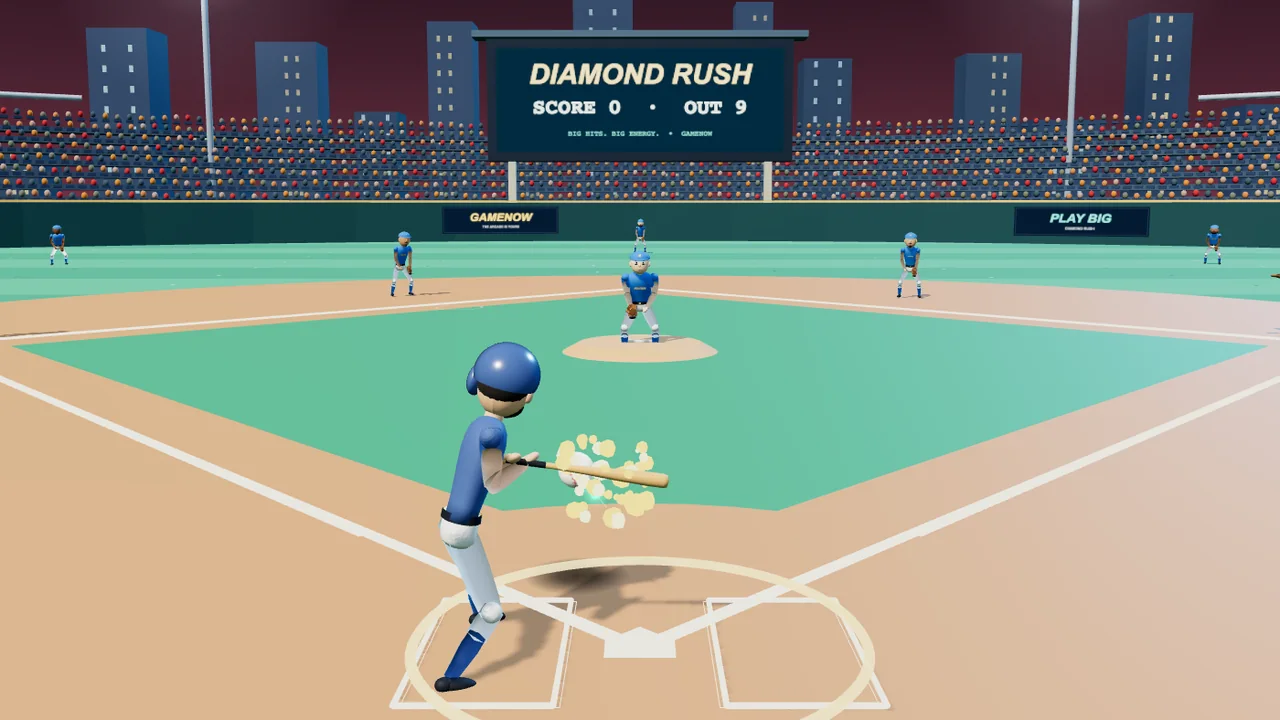
DIAMOND RUSH
Read the pitch and time your swing. Play three innings against AI or invite a friend to a live 1v1 baseball game.