A solo match is three rounds
Since the update of 2026-10-11, solo play against the AI is a best-of-three match. Each round is a complete game: both players start at 1,000 HP, the round lasts up to three minutes, and it ends with a KO or, when time runs out, with the HP lead. A drawn round counts for nobody. If three rounds pass without anyone reaching two wins, more round wins takes the match, and level round wins count as a loss.
Between rounds a screen shows the result, the tally and the next layout, and the HUD keeps a line such as “Best of 3 · Round 2 · Fortress · 1:0”. None of this applies online or in Today's challenge, which are still a single round on the classic layout; the last sections cover them.
Six layouts, one set of rules
Physics, scoring and damage are the same on every layout; only the bricks change. One half of the wall is still copied with a 180° turn, so you and the AI face identical bricks. Every 20 seconds each empty cell has a 35% chance of a new brick, and that refill draws from the layout's own table, so a layout keeps its character for the whole round.
Your very first match opens with Classic, the layout the brick card describes, followed by two special layouts. Later matches draw three different layouts from Classic plus three random specials, so Classic turns up in three matches out of four.
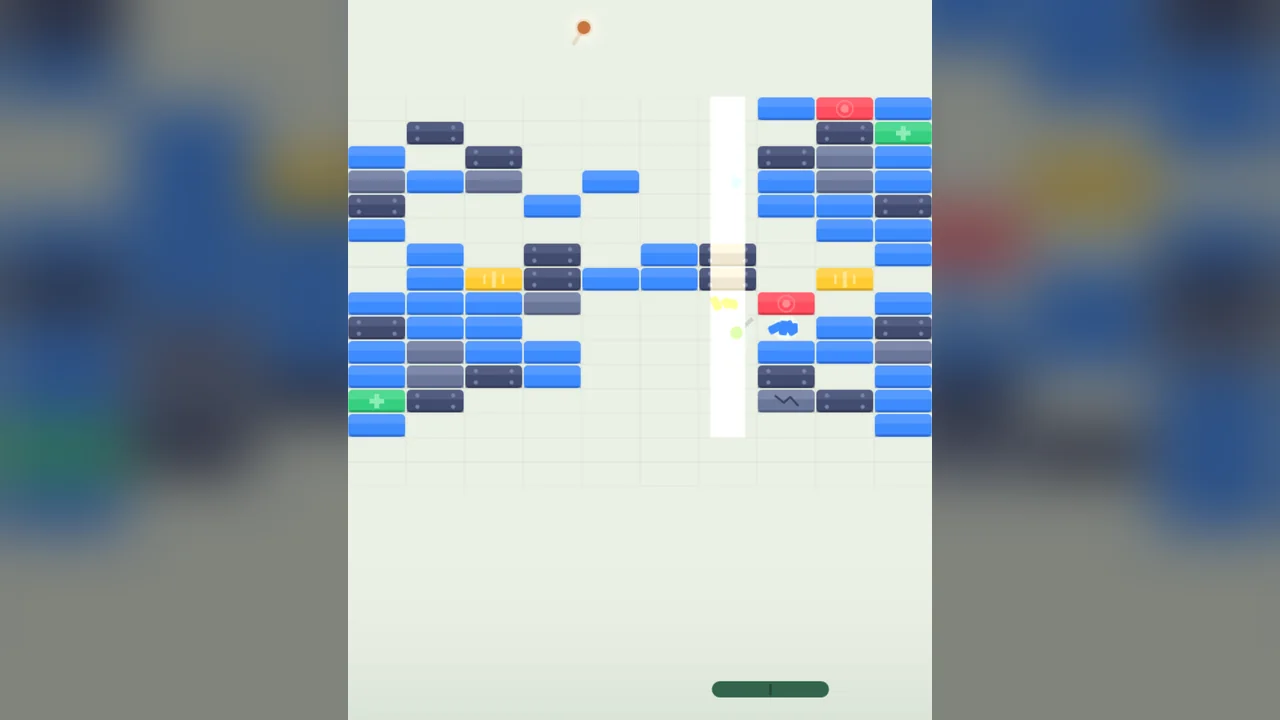
- Classic: every cell drawn at random. Per 100 draws: 56 normal, 17 tough, 6 steel, 6 row blast, 6 column blast, 4 bomb, 4 heal, 1 multiball.
- Fortress: a steel wall two rows thick across the centre, open only in columns 2, 5, 6 and 9 from the left, and a full row of tough bricks second from each end. Refills never add steel or multiball; 30 in 100 are tough.
- Fireworks: fixed rows of blast bricks and bombs, and refills that are 24% blast and 10% bomb. The layout for long chains.
- Oasis: in each half, two heal bricks and two bombs boxed in by tough bricks.
- Pinball: eight fixed steel posts in each half that knock the ball off its line and keep it among the bricks longer.
- Ball Party: four fixed multiball bricks in each half, and refills that are 5% multiball instead of 1%.
The Oasis spring, worked out
Each spring's bombs sit on the side facing the centre line, so the spring your balls reach without breaking tough bricks is the one in the AI's half. Breaking either bomb sets off the other, and the two blasts take both heal bricks with them. Run through the game's rules code, one such hit scored 362 points: 22 HP of damage to the opponent and +100 HP for the ball's owner, up to the 1,000 maximum.
A single shot there can undo two conceded goals. The AI's balls reach the spring in your half the same way, so when you are ahead, that is the area to keep its ball away from.
The final stretch: goals ×2
In solo rounds the last 45 seconds bring a banner, “Final stretch! Goals ×2”, a warning sound and a red clock. A conceded goal now costs 100 HP instead of 50. Brick damage does not double; it stays capped at 50 HP per tick.
I added it because rounds were ending on the clock with both players nearly empty and a gap of a few HP, a result that satisfied nobody. In my bot runs across the six layouts (4,320 rounds), no round was decided on time by fewer than 100 HP.
In practice: a 100 HP lead going into the last 45 seconds disappears with one goal, so clean returns matter more than bricks. If you are behind, every goal you force is worth two.
How brick points turn into damage
The card's rule, 6 HP for every 100 points, is the rate before rounding. Each tick the game adds up the points each player scored, multiplies by 0.06, rounds to a whole number and caps the result at 50. Because the rounding happens every tick, small hits round up:
- Normal brick (10 points): 1 HP.
- Tough brick (25 points, scored only when it breaks): 2 HP.
- Multiball brick (80 points): 5 HP.
- Row blast through nine normal bricks: 40 + 9 × 13 = 157 points, 9 HP.
What that means for aiming
Ten normal bricks broken one at a time deal 10 HP; a full row blast deals 9. Chains raise your score, which has no cap and is what Today's challenge ranks, but for damage the goals do the heavy lifting. Steel scores nothing and survives every explosion, so a rally spent hitting it only gives the AI time.
The useful target in a round is therefore the AI's goal, and bricks matter most as a way to open lanes toward it, or, on Oasis, as healing.
Your first match, step by step
A first session that uses the practice tools in the order they help most:
- Pick Easy. The ball runs at 88% speed and the bounce aid is already on: after each of your returns it marks the contact point with a yellow dot and a short line in the direction the ball left.
- Read the brick card that opens the first time, then play Round 1 on Classic.
- Open the pause menu (⏸, P or Esc) and try the contact drill: three identical balls to meet with the left, centre and right of the paddle. Targets are 0.55 of the half-paddle either side of centre, a contact within 0.25 of the target passes, and the balls arrive at 50%, 75% and full speed. The match stays paused meanwhile.
- After a goal against you, the “Replay goal” chip stays up for 6 seconds. The slow replay shows how far the ball landed from your paddle's centre and how far outside the paddle it was.
- Move up once Easy is comfortable: Normal plays at 100% ball speed, Hard at 112%.
What the practice AI does
The solo AI aims off-centre on purpose and wobbles: its target is pushed up to 280 units either way on Easy, 140 on Normal and 76 on Hard, and each error is held for 0.4 seconds. The paddle is 144 wide, so on Easy the wobble alone can make it miss a straight ball.
There is one exception. If your paddle does not move a single unit for five seconds, the AI switches to a firm mode that returns every straight ball until you move again. It exists so that parking the paddle in the centre cannot win: before it, a parked paddle beat Easy in 26% of my simulated rounds, and now in none.
In the same runs, a bot with sloppy aim won about 45% of rounds against Easy, a steadier one 40% against Normal and a good one 35% against Hard. Over best of three that comes to roughly 42%, 36% and 28% of matches.
Stars and the stage collection
A solo match awards up to three stars: win the match, concede no more than 10 goals per round played, and set off a 4-step chain, four explosions triggering each other, in any round. Every layout you win a round on joins a collection shown as “Stages conquered n/6”, and a first win on a layout announces “New stage conquered”. Stars and the collection are stored only on this device.
Online play and Today's challenge
VS PLAYER is one round on the classic layout at standard ball speed, with no final stretch and no pause. The physics are the same, so angles and chains carry over from practice; the second round does not.
Today's challenge is also a single round on a classic layout the server picks for the day, against the earlier Normal AI (wobble 110), with no final stretch. Your result is your brick score, checked by the server replaying your paddle inputs. Score has no cap there, so chain bricks are worth chasing, but a KO ends the run and the scoring with it.
Common mistakes
Four habits that cost rounds, and the rule behind each:
- Saving an extra ball and losing the original: only the two original balls cost HP, while white-ringed extras simply vanish at a goal line.
- Parking the paddle to wait for the ball: five motionless seconds switch the AI to its firm mode.
- Attacking in the final stretch while ahead: a single goal now costs 100 HP.
- Aiming at steel: it scores 0 points and explosions do not break it.
Play it yourself
Brick Arena
Bounce the ball with your paddle and break bricks. Practice solo or compete in real time.