The collapse is slower than you
The collapse grows from the Pacific in straight segments. Converting its schedule into ground speed on a 1,000 m planet gives the speed of the front as it advances: 2.9 m/s for the first seven minutes of play, 3.3 m/s from 7:00 to 11:00, 3.9 m/s from 11:00 to 14:00, 3.7 m/s for the next 90 seconds and 3.3 m/s in the last 30. Walking is 4.4 m/s and sprinting 7 m/s plus 2% per Mobility point, so on open ground you can always walk away from it.
The danger is anything that drops you below the front's speed:
- Crouching: 2.1 m/s.
- Aiming down sights: speed × 0.62, and you cannot sprint, so 2.7 m/s.
- Water: a flat 2.8 m/s whether you sprint or not, slower than the front at every stage.
- Healing: speed halved, so 3.6 m/s even while sprinting, slower than the front between 11:00 and 15:30 of play.
- Caught inside, you have 5 seconds to step out, 1 second in the last 30. Leaving resets that timer.
A first match, in order
Spend one session in the Training Range first. Its ability cooldowns are a quarter of normal, so you can try all three abilities in a few minutes, and loadout changes take effect without leaving.
In a real match the 20-second countdown is for the globe. The server only accepts a landing spot at least 410 m from the final point that will still exist 7:20 into play. The drop from 110 m lasts about 15 seconds, and you face the nearest hub when you land. From there the HUD names your next hub with its distance and the time before it collapses, and a compass and light beam point the way.
On a gamepad, sprint is a click of the left stick, RB fires your ability, LB heals, Y cycles weapons and clicking the right stick opens a crate, or starts transport when you stand on a launch pad.
What the three loadout points really do
You split exactly 6 points between Stability, Mobility and Survivability, 0 to 3 each. Survivability adds 5 maximum health per point, from 100 to 115. Mobility adds 2% to sprint speed only, from 7.0 to 7.42 m/s; walking and crouching are unchanged. Stability makes recoil settle 4% faster per point. It does not touch a weapon's base spread, and in sustained AR-7 fire the difference between 0 and 3 points works out to about 5% of the cone.
Survivability matters at one threshold above all. At 100 health, four AR-7 body hits (104) kill you and so does a full SG-2 blast of eight body pellets (104). From 105 up, both leave you standing. Points 2 and 3 do not change how many AR-7 or SR-4 hits you can take, since no mix of 26s and 39s lands between 105 and 115; they help against pellets in the head and against damage from several weapons. The default 2-2-2 already puts you at 110.
Weapons: hits to kill and honest range
Each shot leaves the barrel at a random offset inside a cone, and aiming shrinks the cone to 35%. A body is three stacked spheres about 0.92 m wide, so the cone decides at what distance even a perfectly placed shot can miss. The figures below are calculated from the weapon values at the default 2 Stability point; they are not measured from play.
Headshots count when a shot strikes the upper part of the top sphere, about 1.62 m above a standing player's feet.
- AR-7: 26 per hit, 39 to the head, 30 rounds, one shot every 0.12 s. From the hip, steady fire starts to miss a body beyond roughly 74 m; aimed, it stays inside a body almost to its 220 m range. Three headshots kill anyone.
- SR-4: 65 per hit, 130 to the head, 8 rounds, 0.9 s between shots. Two body hits kill anyone, since nobody has more than 115 health.
- SG-2: eight pellets of 13, or 16 to the head, every 0.85 s, 55 m range. From the hip every pellet stays on a body out to about 15 m; aimed, out to about 44 m. Against the default 110 health, even a perfect body blast needs a second shot unless two pellets hit the head.
Actions that cancel each other
The server lets you do one thing at a time, and starting a new action silently drops the old one.
- You cannot fire while reloading or healing.
- Reloading cancels a heal in progress, and healing cancels a reload.
- Switching weapons cancels both. A reload interrupted this way adds no rounds.
- Taking any damage cancels a heal. The kit is kept, but a new heal needs 3 seconds without being hit.
- Starting a transport cancels reloading and healing.
Ammo goes to the gun in your hands
Every weapon keeps its own magazine and reserve, and every pickup adds rounds to whichever weapon you are holding at that moment. A supply crate gives two of that weapon's magazines, so 60 rounds for the AR-7 but 16 for the SR-4 and 12 for the SG-2. A loot pack gives one magazine, and capturing a hub gives 30 reserve rounds to the held weapon. Switch to the gun you are short on before you press E or before the capture completes.
Crates sit about 14 m from each hub centre and need you within 5 m. There is one at each of the four land hubs, at The Last Meridian and at each of the three Sea Links on the final deck.
Captures, the final deck and transport
A capture needs you alone within 12 m of a hub centre for 5 unbroken seconds. If anyone else enters, or you step out, progress drains, and the next attempt starts again from zero. Only your first capture of each hub scores, up to four.
The four points on the final deck also count as hubs: The Last Meridian in the centre and three Sea Links about 205 m out. A player who reaches the deck early can collect captures there instead of across continents.
Transport works within 18 m of any hub centre. The destination must not collapse within 15 seconds of departure, the trip lasts 6 seconds and cannot be shot at, and you must wait 20 seconds before the next one. Unless you pick a destination on the globe, the game suggests the nearest hub you have not reached yet that will survive your walk there plus 30 seconds. With under three minutes left, or within 260 m of the final point, it suggests The Last Meridian.
How the bots see, aim and heal
Every seat without a human is a bot with the default 2-2-2 loadout. Their behaviour comes from a few fixed rules:
- Sight: they consider only enemies within 150 m and about 72° either side of where they face, and check line of sight to the three nearest. Approaching from behind or the side is genuinely safer.
- Aim error is a fixed angle, so distance works for you. Even after tracking you for 1.5 seconds, their sideways error is up to 2.6° to 4.2°, which at 60 m is ±2.7 to ±4.4 m against a body under 1 m wide.
- Rhythm: a new target gets 0.6 to 1.5 seconds before they fire, and with the AR-7 they fire in half-second bursts. Seeing them first usually means shooting first.
- Heals: in a fight they heal below 45 health; otherwise when more than 30 below maximum. Both need 3 seconds without damage, so keeping pressure on a hurt bot stops the heal.
- Loot: they start with two kits and only detour to crates or loot within 60 m when they hold fewer. Early crates are mostly contested by humans.
- Movement: they search near where they landed for 2:30 to 6:00 of play, then patrol 55 to 120 m from the nearest hub, so hubs get busier a few minutes in.
Playing for score, alone or with friends
Placement gives 500 × (48 − place) ÷ 47 points, so each place is worth about 10.6, and first place adds a 200-point bonus on top. Moving from second to first is worth 211 points, as much as about twenty places lower down. A first capture is worth 50, the same as five AI kills or almost five places. Kills cap at 300.
Players who die are placed by the time they went down, whether the collapse or a gun did it. If several are alive at 0:00, remaining health as a share of maximum decides first, so Survivability points do not help there, but a heal or a crate in the last minute does.
Deploying solo opens a public room with 8 human seats; start before anyone joins and the other 47 are bots, each kill worth 10. With friends, every human counts 30 per kill and up to 16 humans share the room, so other players are the most valuable and the most dangerous targets. A friend room's human seats are set to 2, 4, 8 or 16 when it is created.
Play it yourself
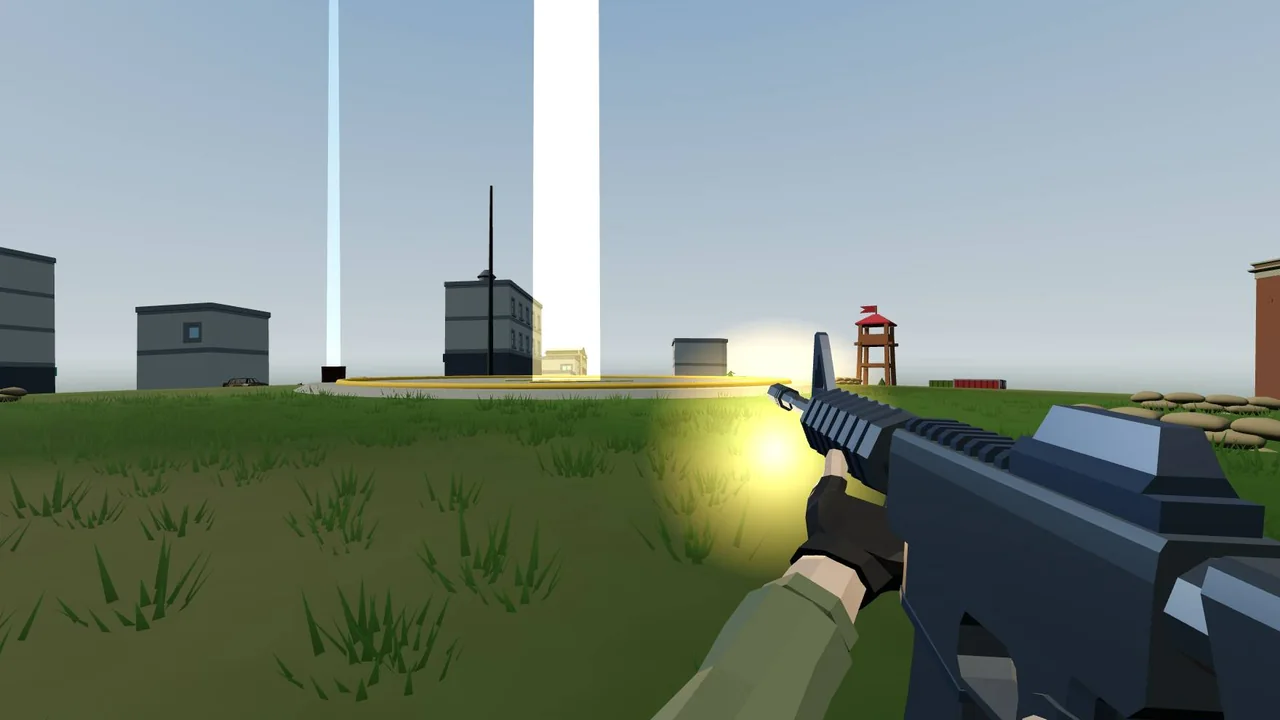
BATTLE EARTH
The whole Earth, shrunk to a 1 km radius, is the battlefield. Outrun the collapse spreading from the Pacific, resupply at hubs and outlast up to 48 humans and AI.